Match Preparation in Football: a Week Built Backwards From the Game
Preparing a team for a match is not one talk on the day. It starts with the fixture, runs through both shapes and the team sheet, and gives every training day before it a job.
Match preparation is everything a coach decides between one game and the next: who you play and when, how they line up against how you do, who is fit, who starts, what each training day is for, and what you say before kick-off. Every one of those has to be decided anyway. Preparation is deciding them in order, in one place, early enough to train for them.
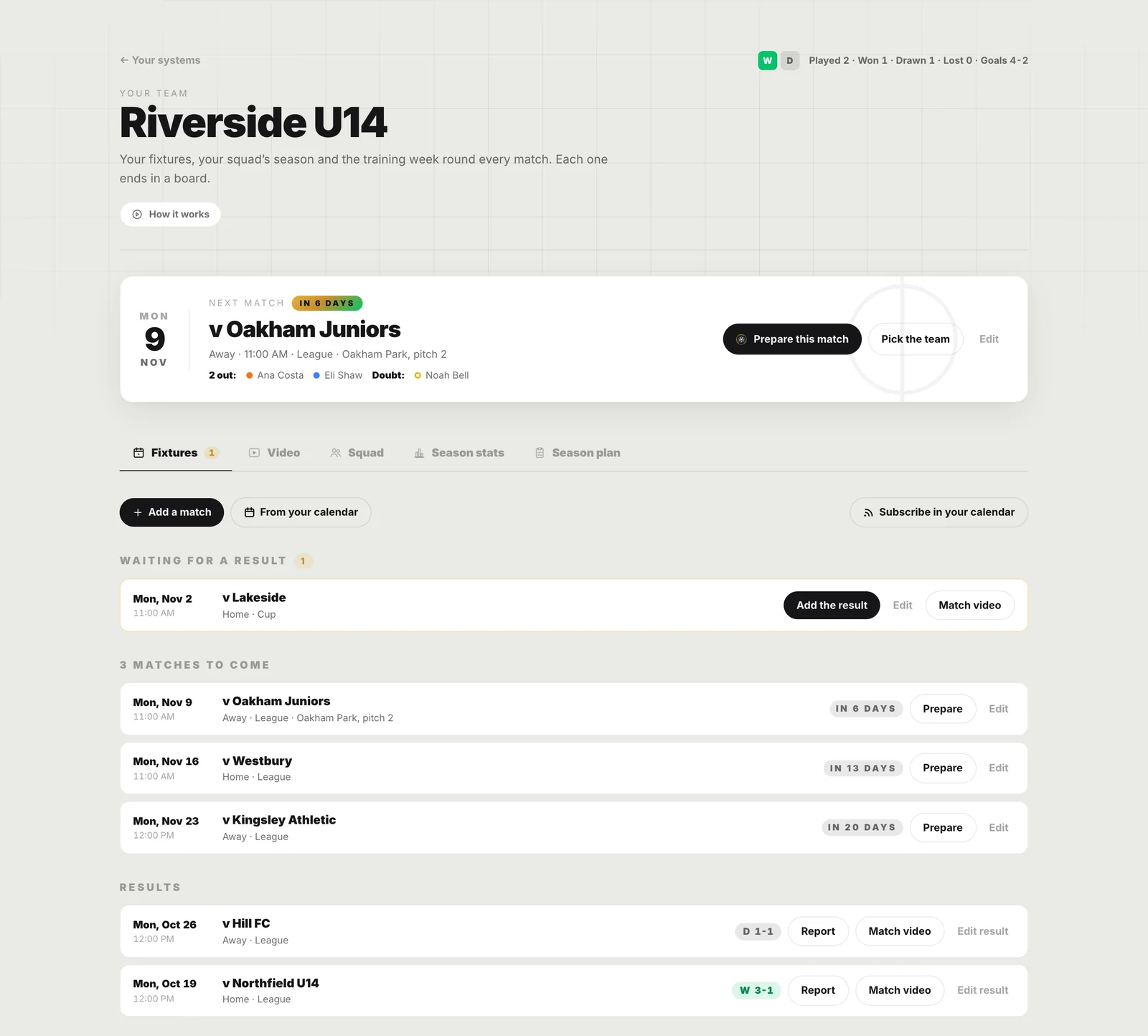
Start from the fixture
Put the fixtures in first, because every other date in the week is counted from them. Add a match by hand, or paste your league or club calendar link and check every match before it is saved. When a kick-off moves, read the link again: the match moves to its new time and is never added twice.
A private calendar link carries every match, and every training day of your season plan, into Google Calendar, Apple Calendar or Outlook, for you, your staff or the parents. It never carries a player: no names, no team sheets, no availability.
Put both shapes on one pitch
Pick your shape and theirs. Both go on one pitch, theirs turned round, and five match-ups are counted the same way every time: at the back, in central midfield, up front, and on each flank. Here is a 4-3-3 against a 4-4-2:
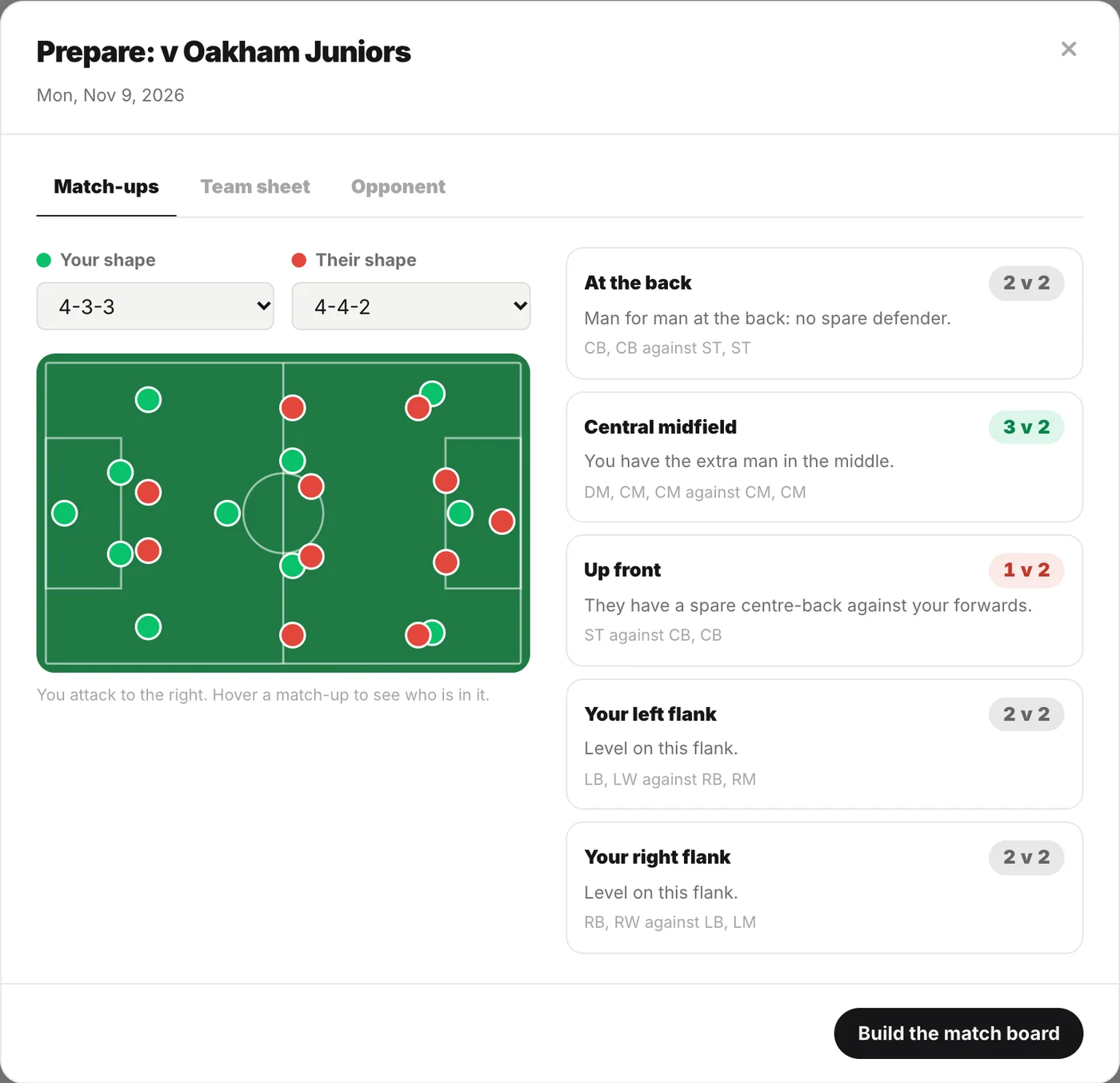
Read the numbers before the drawing. The 3 v 2 in the middle is the extra man to use. The 1 v 2 up front is the problem: they have a spare centre-back against your forwards. A week of preparation is one answer to each, and one press turns the comparison into a match board you can move.
On the board The 4-4-2 Mid-Block What a 4-4-2 does without the ball: two banks of four 6 phases →The shapes themselves are on the formation pages: the 4-3-3, the 4-2-3-1, the 4-4-2 and three at the back, each with where it is weak and the fix.
Know the opponent
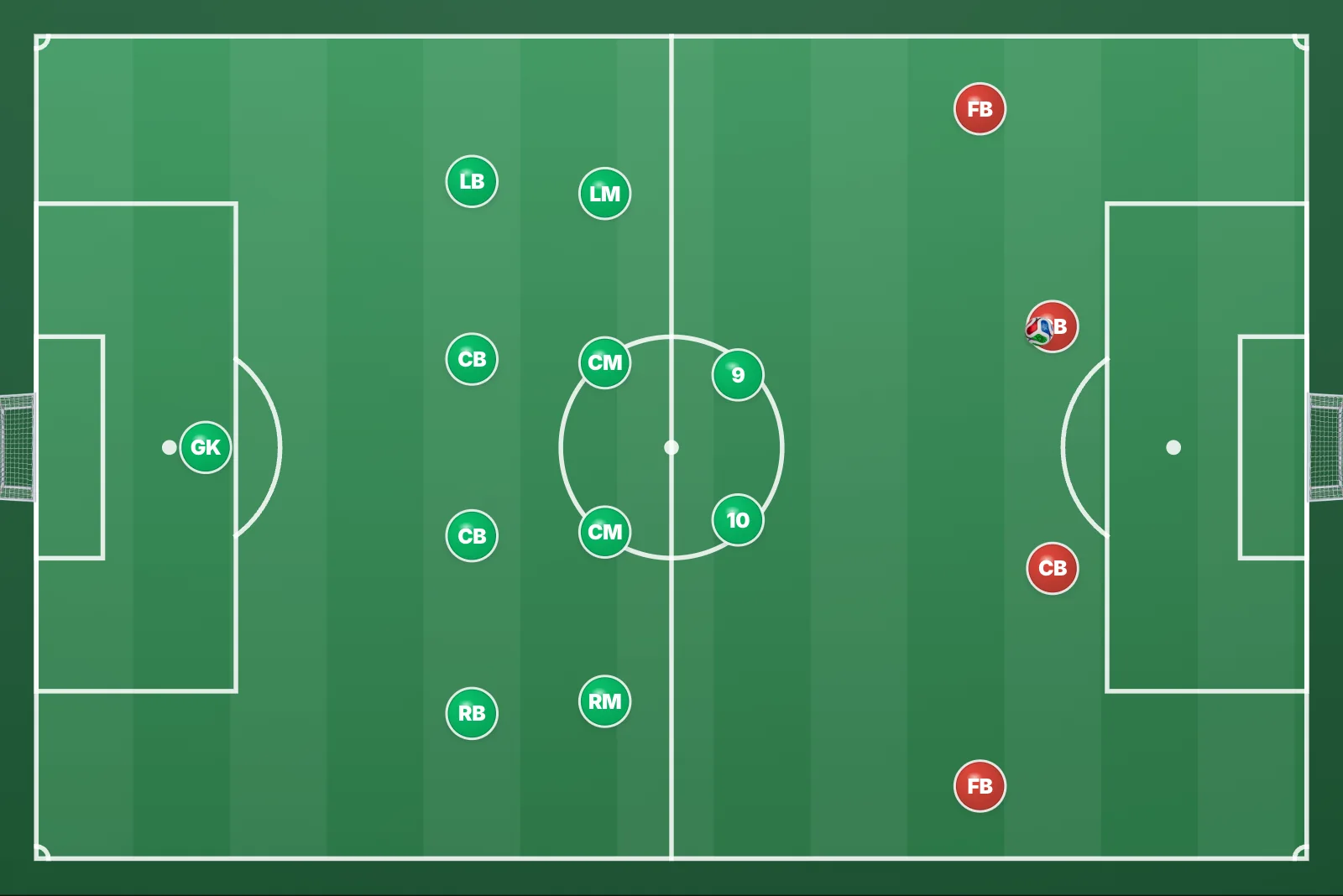
Keep a few lines on each opponent: how they usually line up, how they play, the players to watch. They come into match prep with your results against them, so the second meeting starts where the first one left off. If they play a narrow midfield, the board that beats it is already in the library.
On the board How To Beat A Diamond A narrow midfield, beaten by the far touchline 6 phases →Give every training day a job
Count the week from the match. The day after a game is recovery, the middle of the week carries the work, and the day before is activation. In the season plan you answer four questions once (when the season runs, which days you train, up to three things to get better at, and what players are rated on) and every training day gets its job from where it sits against your matches.
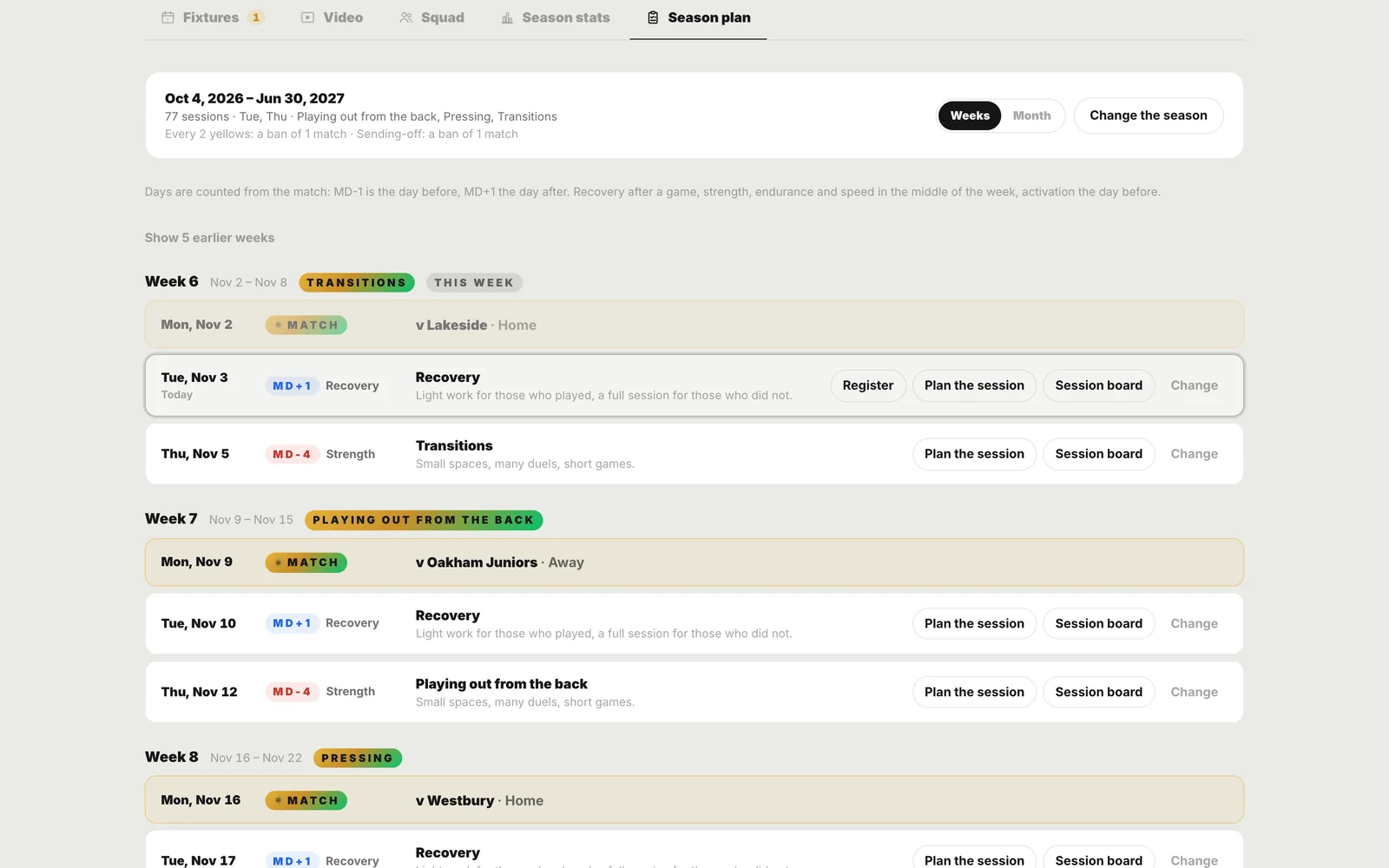
On a training day, take the register: who came, how hard it was (RPE, 1 to 10) and how long it ran. Plan the session from that same day and it is already dated; how to plan a football training session covers the session itself.
Say it once, so they can watch it twice
The team talk is the last piece, and the easiest to lose: said once in a changing room, half-heard by a substitute tying his boots. Record it over the board instead. Step through the phases, draw as you talk, and your players get one link that plays your voice in time with the board, in any browser, with no account.
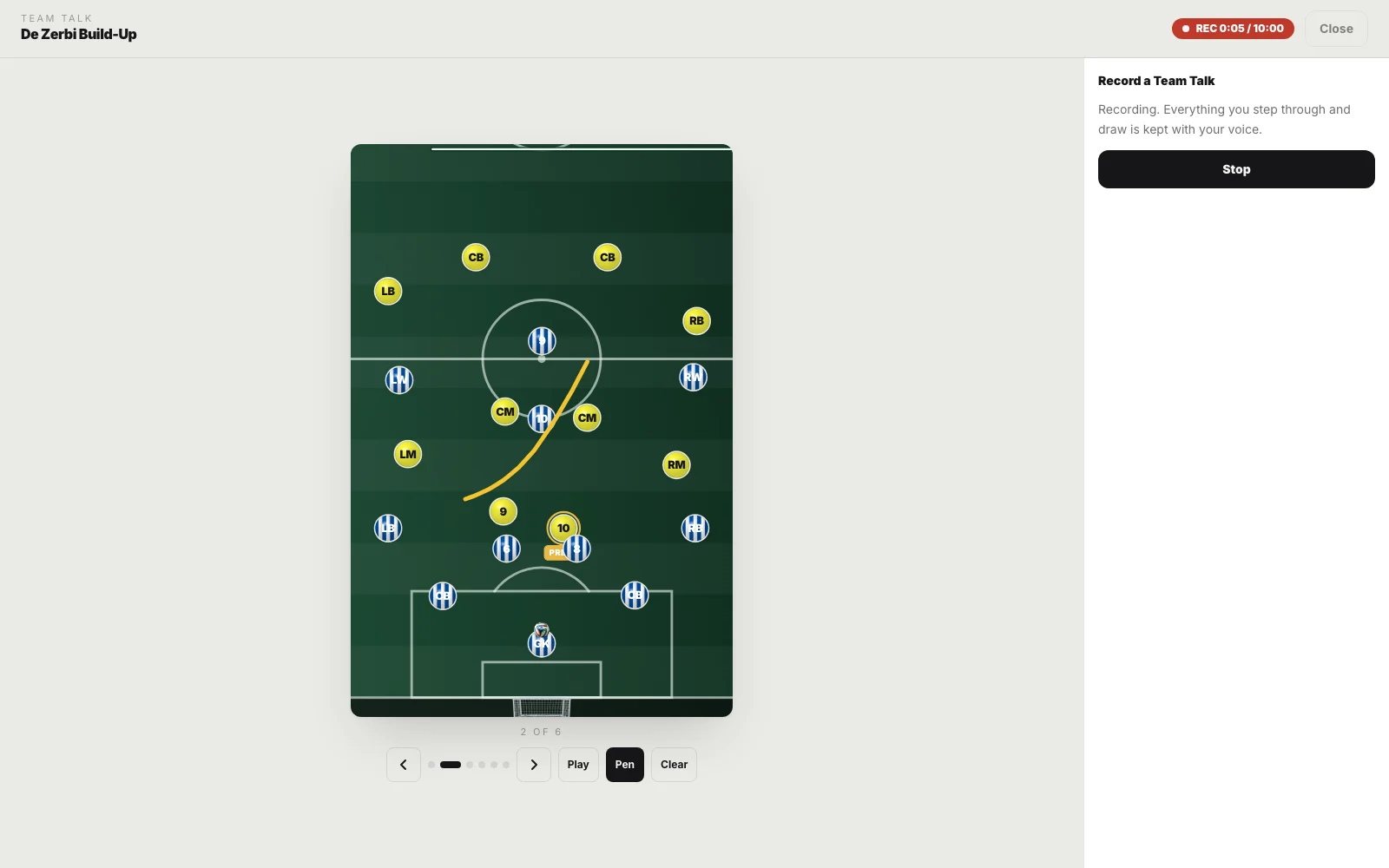
If the plan is to press, the talk should name the trigger, so every player goes at the same moment. Live present mode, to present the board live wherever the squad is and pass the pen to your staff, is on Pro.
On the board When To Press The four triggers, on the board 6 phases → In the Studio Prepare your next match Your fixtures, both shapes on one pitch, and a board that moves. Open Studio →Who is fit and who starts is the other half of the week: how to organise a football squad.
Drawn from
Every claim above is on one of these boards.
Nothing in this post teaches something the diagrams do not show. That is a rule, not a coincidence: the article is written from the systems, never the other way round.
The notebook
One system, explained, every week.
The diagram, the principle, and the detail most people miss. Unsubscribe in one click.
Follow along
Watch the systems move.
Short tactics reels, every frame drawn, no broadcast clips. Follow along wherever you scroll.
Read next
Moving Beyond X's and O's: Designing Drills with Digital Training Gear
Coaches are visual learners, but a tactical board with just arrows leaves too much to the imagination. Enter digital cones, mannequins, and hurdles.
Visualizing Roles: Why Player Images Fix Broken Tactics
A generic number 6 on a whiteboard is an abstract concept. But when a player sees their own face on the tactical board, they instantly understand their responsibility.
Why Every Coach Needs a Premium Tactics Board Tool
The days of static arrows on a whiteboard are over. The modern game requires a tool that actually moves.