Four lines · two holders · one 10
The 4-2-3-1 formation, explained
A 4-2-3-1 is four lines: a back four, two holders, three attacking midfielders and one striker. The two holders are what let the full-backs go. In its resting shape the centre-backs stand 22 m apart and the 10 sits 16 m below the 9. Without the ball it becomes a 4-4-1-1, and the game is often decided by their holder against our 10.
 Total Football StudioPausedThe 4-2-3-101 / 05
5 phases, one film
- Between the centre-backs
- 22 m
- From the 10 to the 9
- 16 m
- Phases on the board
- 5
Measured on the board, on a 105 x 68 m pitch. A coaching guide from The 4-2-3-1 Playbook, not a law: adjust it to your players and your pitch.
Phase by phase
The 4-2-3-1, as the board plays it.
-
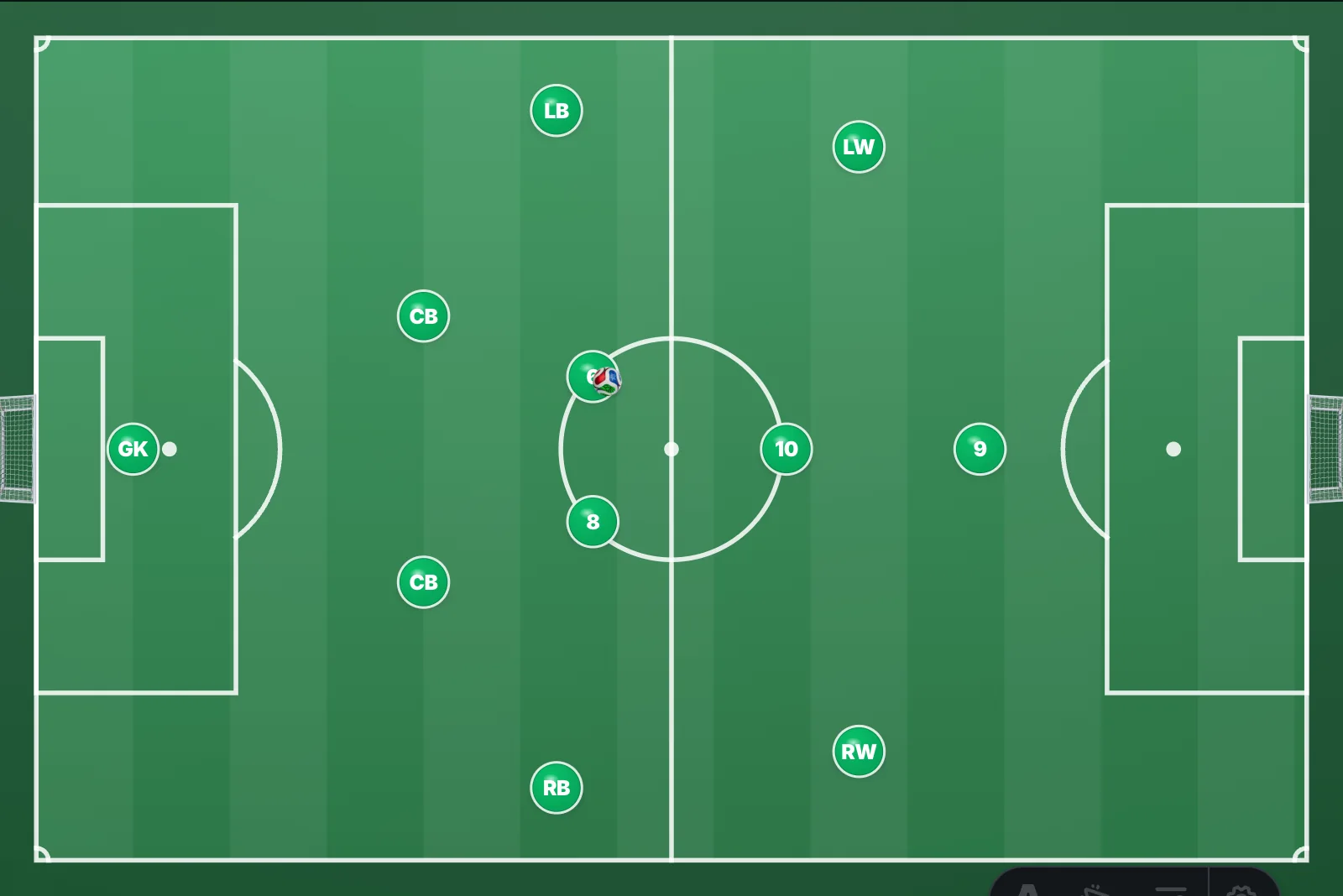 01
The resting shape
Centre-backs 22 m apart. The 10 sits 16 m below the 9.
Each line has one job with the ball and one without it. The centre-backs split wide enough that one presser cannot cover both, the 10 stands close enough to the 9 to combine and far enough not to share a marker, and nobody stands in a straight line with a team-mate if he can avoid it.
-
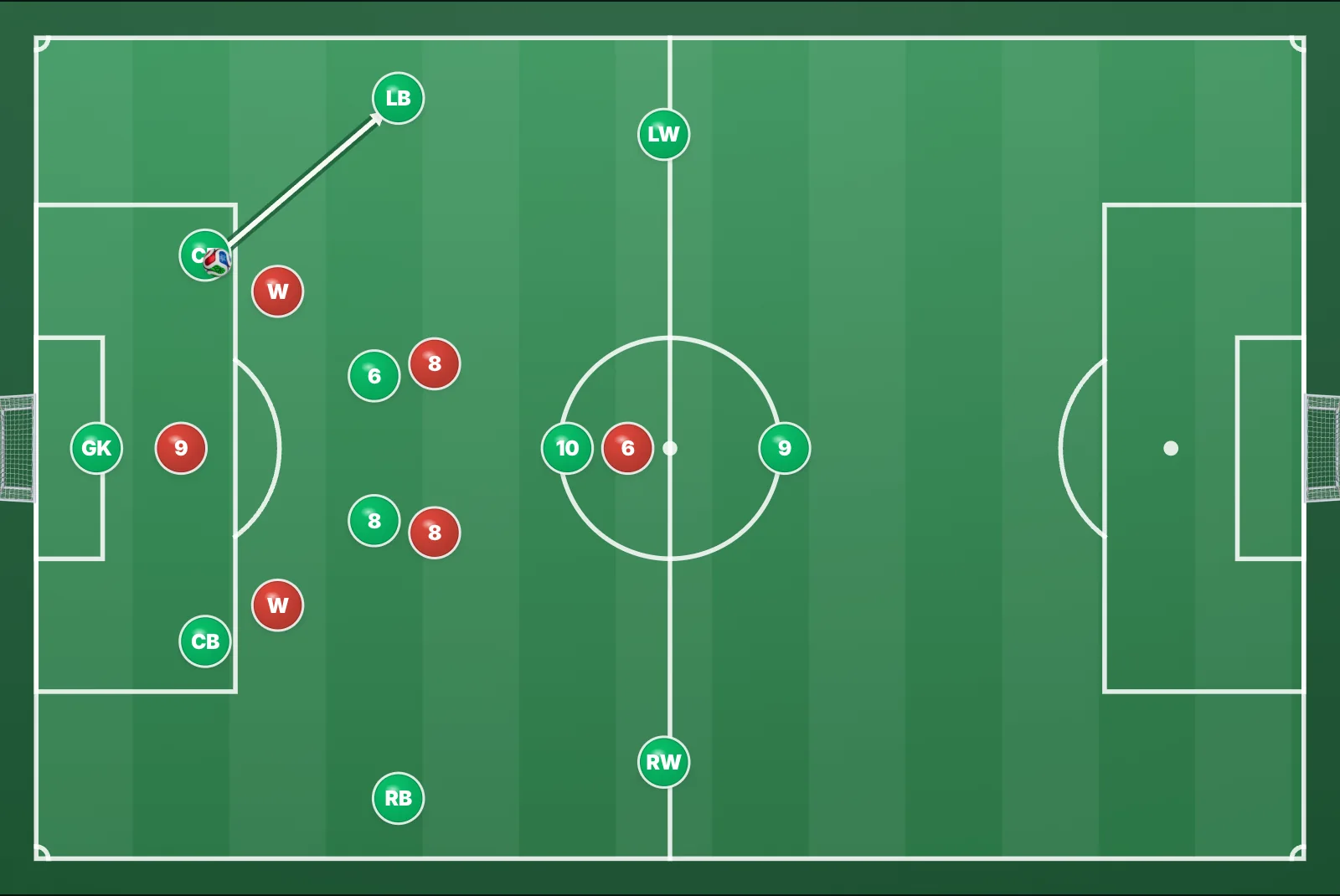 02
Four against three
Their front three press our centre-backs and the keeper. The left-back is free.
Against a front three, their forwards press our centre-backs and the keeper. They cannot cover four defenders and the keeper, so one full-back is always free. If their 8 jumps onto our holder to help, the 10 is free behind him.
-
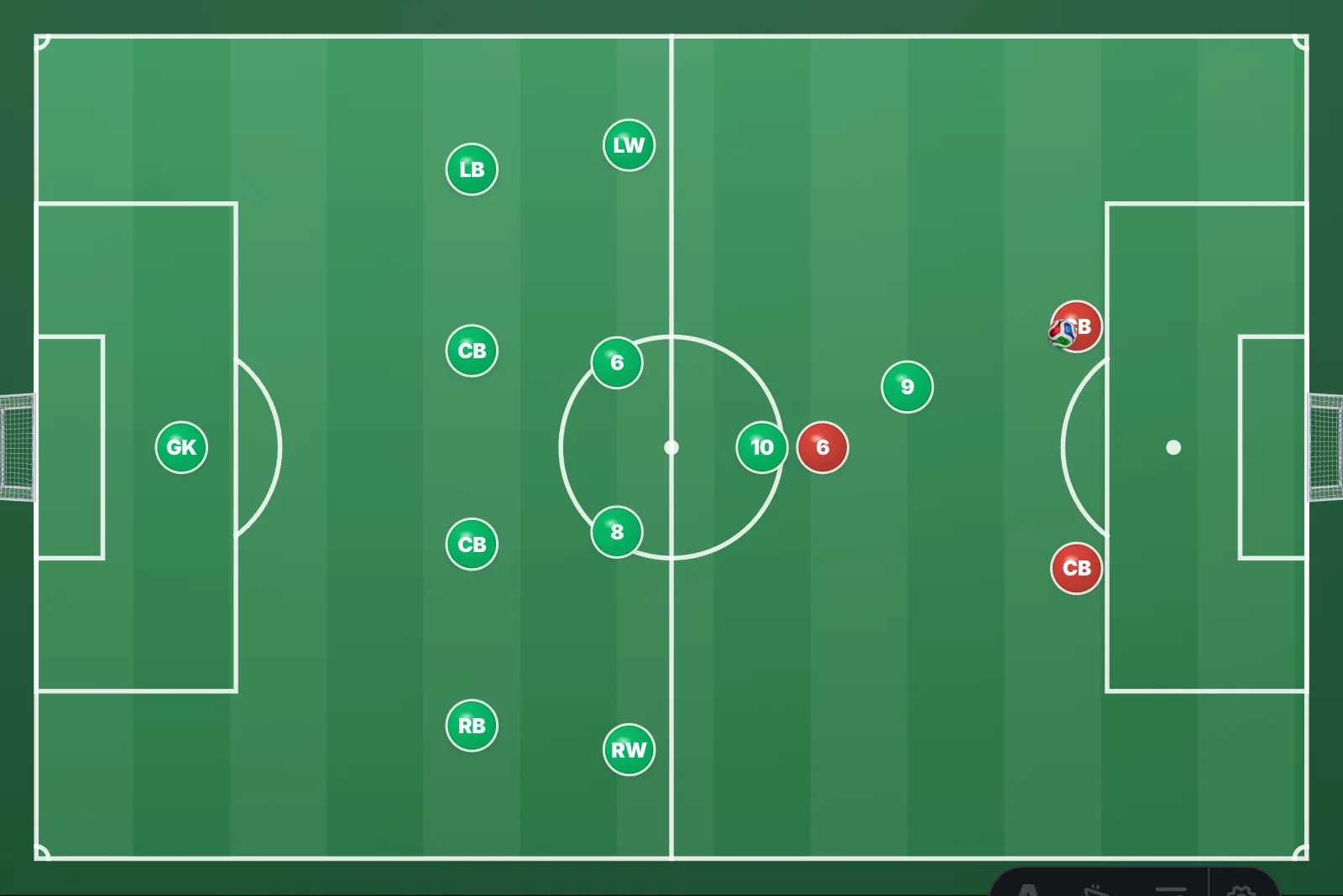 03
Without the ball: 4-4-1-1
The wingers drop beside the holders. The 10 takes their 6.
Without the ball the wingers drop beside the holders and the shape is a 4-4-1-1. The 10 marks their single holder and the 9 starts the press, so we stay three against three in the middle.
-
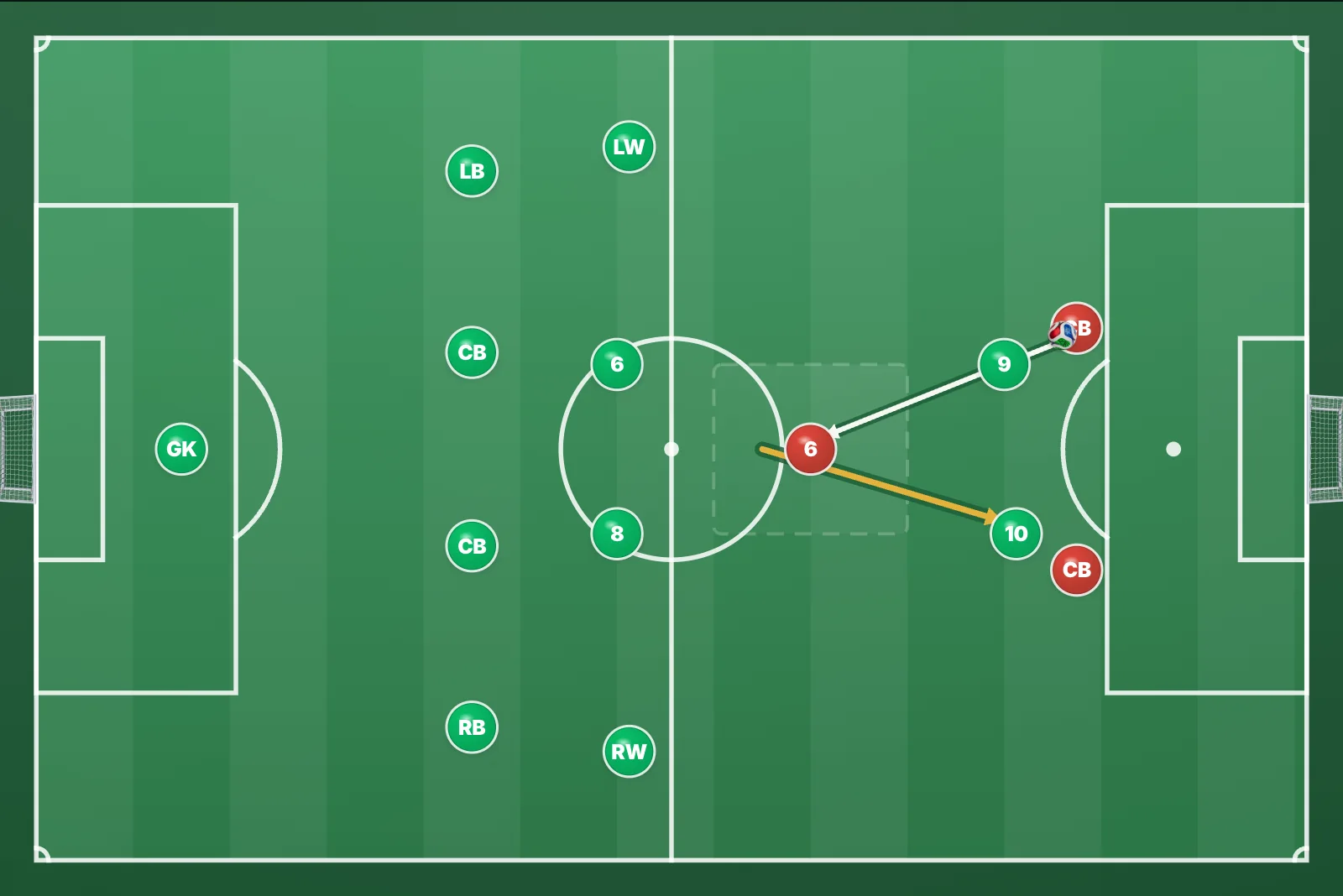 04
The duel that decides it
Our 10 jumps to their centre-back, and their 6 turns, free, between our lines.
Their single holder against our 10 decides the game. If the 10 leaves him to press a centre-back, their 6 receives between our lines facing forward, and our two holders have to choose between him and their 8s.
-
 05
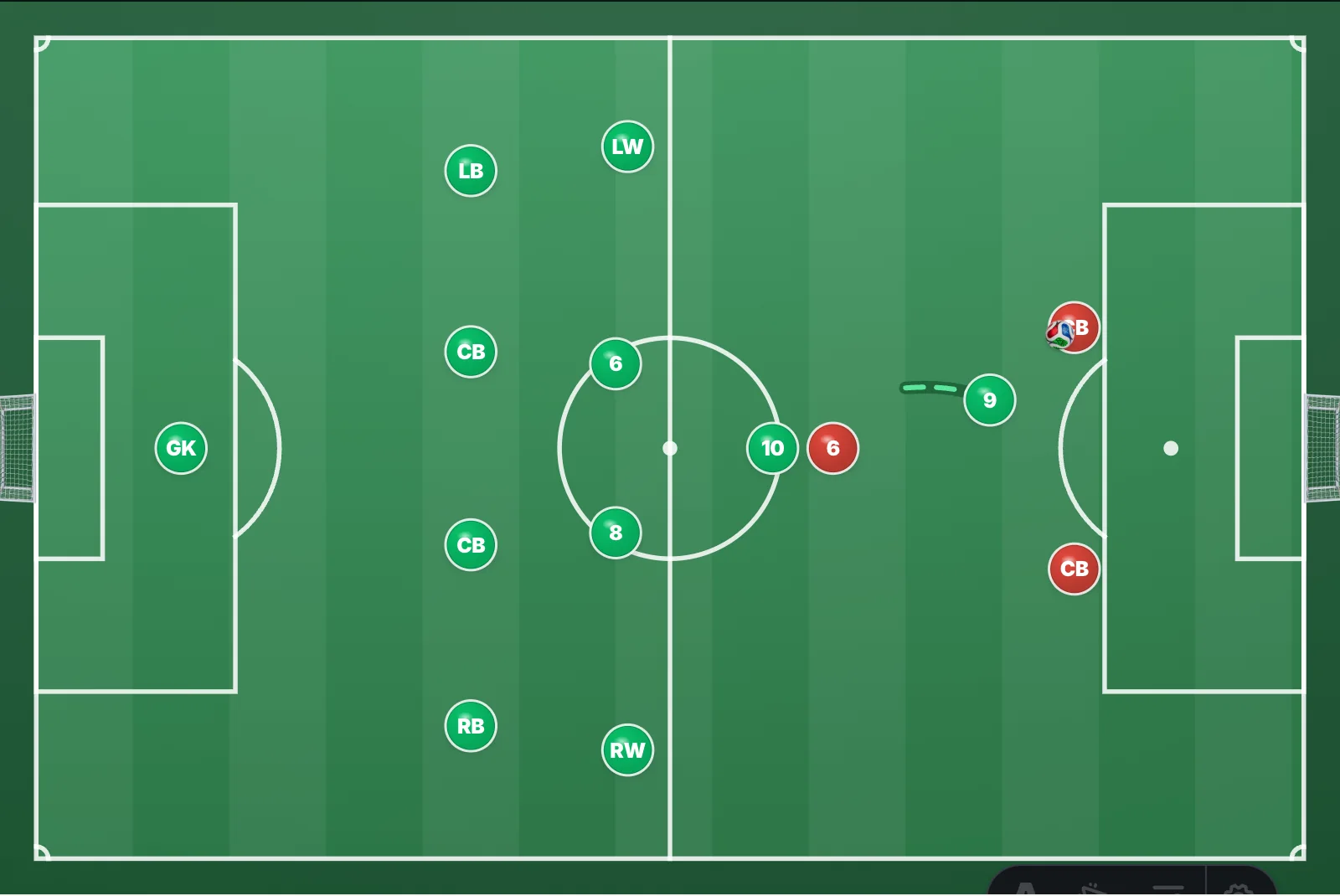
The fix: the 10 stays on him
The 9 presses alone, on a curve that cuts off the other centre-back.
The 10 stays on their 6 and the 9 presses alone, on a curved run that blocks the pass to the other centre-back. Their build-up goes wide, which is where our wingers are waiting.
The roles
Who does what in a 4-2-3-1.
- Goalkeeper
- The extra player in the build-up, the plus one against a press.
- Centre-backs
- Split towards the corners of the box to start the attack; hold the line and defend the box without the ball.
- Full-backs
- Start high and wide, because two holders cover behind them. Both can go.
- The two holders
- Connect the back to the front with the ball, screen the centre and stop the counter without it.
- The 10
- Finds the pocket between the lines; without the ball, marks their holder.
- Wide attackers
- Inside forwards who find space between the lines, then drop to make the midfield four.
- The 9
- Pins both centre-backs with the ball, starts the press and blocks one side without it.
What it gives you
- Two holders in front of the back four, so both full-backs can attack.
- Four against three against a front three: one full-back is always free.
- A 10 between the lines who makes their midfield choose.
- One shape that turns into a 4-4-1-1, a 4-4-2 press or a 3-2-4-1 in attack.
Where it is weak, and the fix
-
Their 6 against our 10
Fix The 10 stays on him; the 9 presses alone, curving.
-
A lonely 9
Fix The 10 and the inside forwards arrive near him.
-
A press of three against a 4+2 build
Fix Drop a holder between the centre-backs, or invert a full-back.
-
Their 8 running beyond
Fix A holder follows him, or the back four passes him on.
Playing against it
How to beat a 4-2-3-1.
- 1 Free your holder from their 10. If he gets the ball facing forward, the 4-2-3-1 has no one left to step.
- 2 Pull one holder out with a dropping forward and play into the space he leaves.
- 3 Attack the side where their winger did not drop: a full-back high with no help.
- 4 Against a 4-3-3 our two 8s face their two holders; run one beyond and make a holder follow.
The whole system, in a book
The 4-2-3-1 Playbook
The 4-2-3-1 is where your players stand at kick-off, not what they do once the ball moves. This playbook shows how the same eleven starting positions become a 3-2-4-1, a 4-3-3 or a 2-3-5 with the ball and a 4-4-2 without it, with every idea drawn to scale and every pattern tied to a session.
Asked about the 4-2-3-1
The next questions.
Why is the 4-2-3-1 so common?
It is a starting position, not a system. The same eleven can attack as a 3-2-4-1, a 4-3-3 or a 2-3-5 and defend as a 4-4-2 or a 4-4-1-1, so a coach can change how the team plays without changing who stands where at kick-off.
What is the difference between a 4-2-3-1 and a 4-3-3?
Two holders and one 10 against one holder and two 8s. The 4-2-3-1 gives more cover in front of the back four and lets both full-backs go; the 4-3-3 has more men arriving in the box.
What does the 10 do without the ball in a 4-2-3-1?
He marks their holding midfielder while the 9 presses. If he leaves him, their 6 turns between our lines and the press is beaten in one pass.
How does a 4-2-3-1 build up against a 4-4-2?
One holder drops between the centre-backs. Their two forwards cannot press three, so the free centre-back carries the ball into midfield, while the 10 drops between their two central midfielders.
Other formations
-
Back four · midfield three · front three
The 4-3-3 formation, explained
-
Two banks of four · two up front
The 4-4-2 formation, explained
-
3-4-3 · 3-5-2 · a back five without the ball
Three at the back, explained
In the library