How to Plan a Football Training Session, Block by Block
A session plan is four decisions per block: what it is for, how long it runs, how big the grid is, and what the players have to get right. Write those down and the session runs itself.
Most session plans fail on the grass for a dull reason. The plan said "rondo", and nobody knew how big the square was, how many were inside it, or what counted as a point. The coach knew. The assistant putting the cones out did not, and the players found out by getting it wrong for five minutes.
A plan that works is one somebody else could run. That means every block carries the same few things: the part of the session it belongs to, its minutes, its grid in metres, the organisation in one sentence, the rules, and what you will say while it runs.
Four parts, each with one job
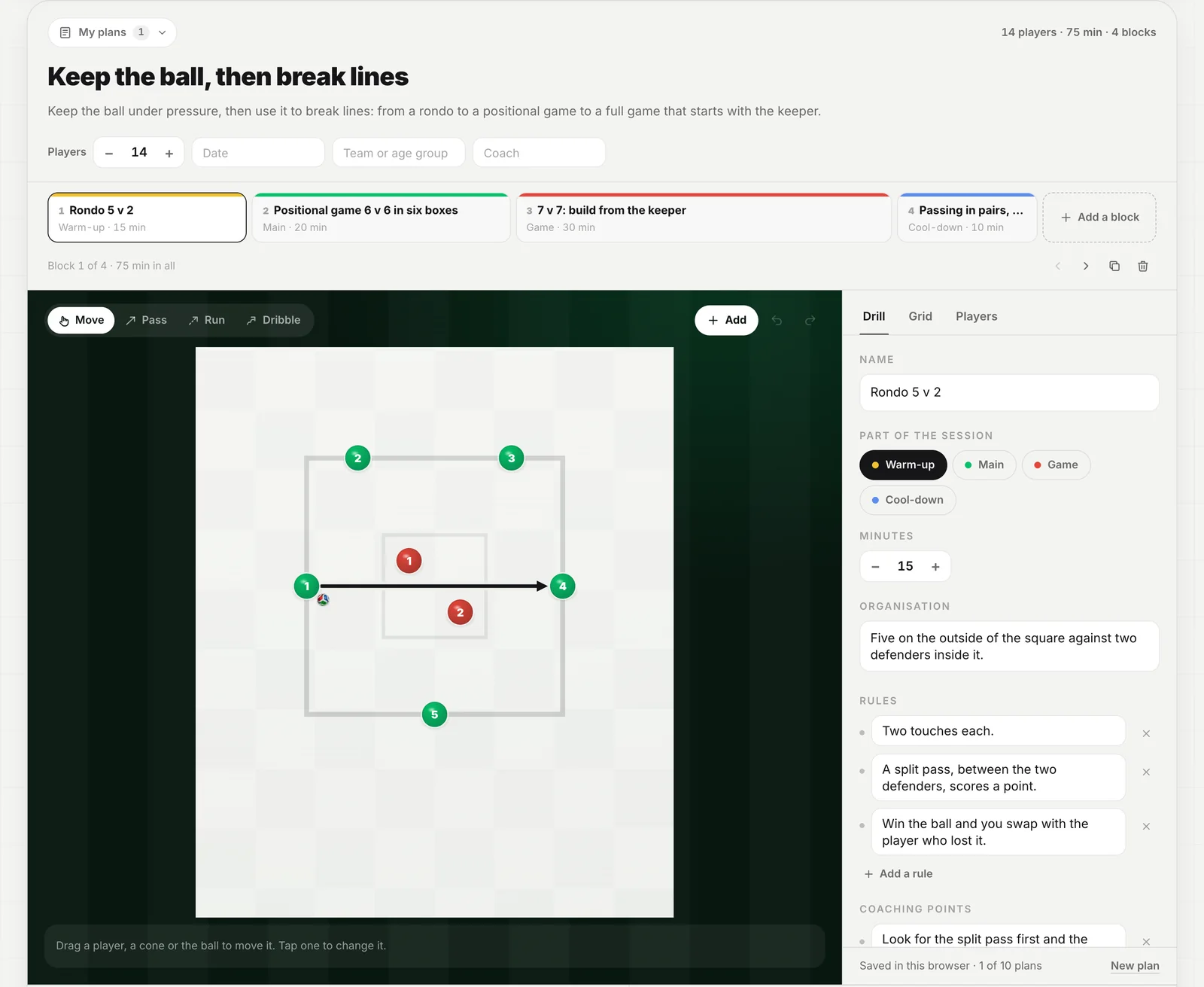
Split the session into Warm-up, Main, Game, Cool-down. Each block belongs to one of them, and the minutes add up to the session. The ready session on the free session planner is a fair example of the shape:
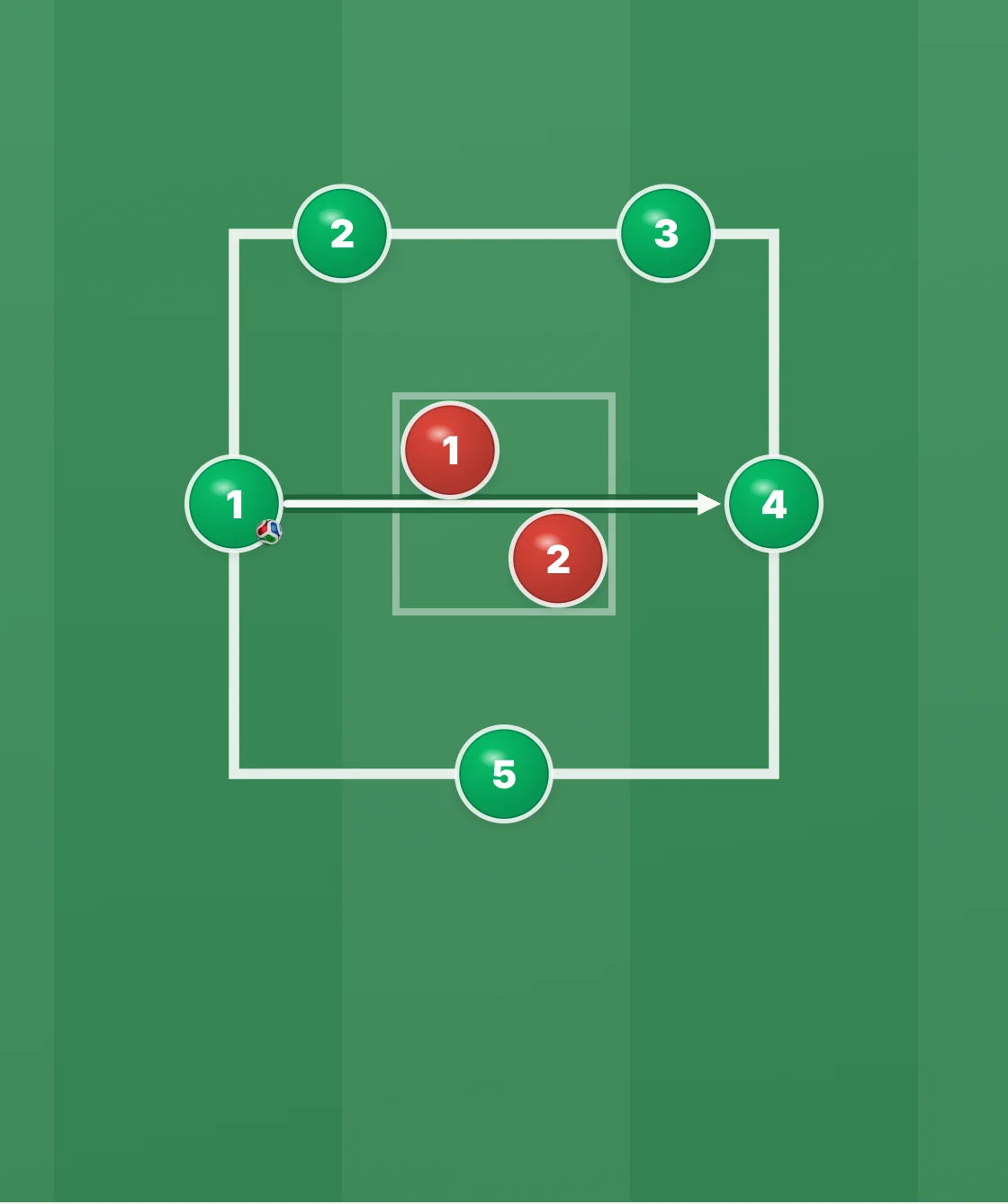
- Rondo 5 v 2: Warm-up, 15 minutes, on a 15 by 15 metre grid.
- Positional game 6 v 6 in six boxes: Main, 20 minutes, on a 40 by 30 metre grid.
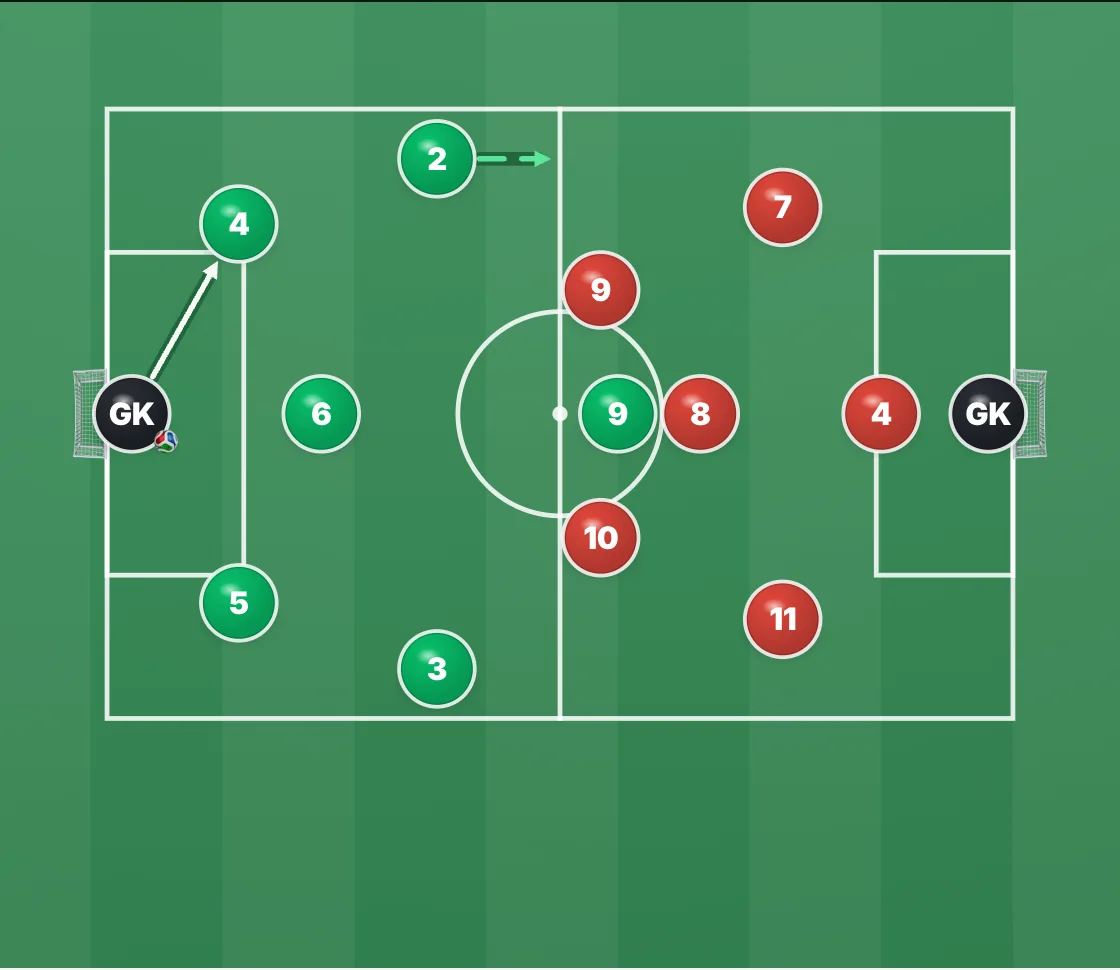
- 7 v 7: build from the keeper: Game, 30 minutes, on a 55 by 37 metre grid.
- Passing in pairs, then stretch: Cool-down, 10 minutes, on a 20 by 20 metre grid.
That is 75 minutes for 14 players, and every block leads into the next: keep the ball in a small square, then in a positional game, then in a full game that starts with the keeper.
Draw the grid to scale
The grid is the drill. Write its size down in metres and draw it to scale, so the coach putting the cones out and the players reading the plan see the same square. On the planner every block is a real board on a grid drawn to its size, and you move the players, the cones and the ball on it.
Rules and coaching points are not the same thing
Rules change the game. Coaching points are what you say while it runs. Keep them in separate lists, because a player can follow a rule without being told twice, and a coaching point is only worth saying when it is short enough to shout. Take the rondo above:
- Rules: Two touches each. A split pass, between the two defenders, scores a point. Win the ball and you swap with the player who lost it.
- Coaching points: Look for the split pass first and the safe pass second. Never stand in line with a defender and the ball. Play the ball to the side away from the pressure.
- When it gets easy: A split pass only counts if it is one touch.
A plan that works is one somebody else could run.
One block for what Saturday asks
The main block and the game should look like the match you are preparing for. If the team is learning to play out from the back, end with a game that starts with the keeper, the way the ready session ends with its 7 v 7.
If the week is about winning the ball back, the same logic runs the other way: the game should give the press something to press, and the coaching points should name the moment to go.
On the board When To Press The four triggers, on the board 6 phases → On the board The Pressing Trap The door you leave open on purpose 6 phases →Print it, then take it to the grass
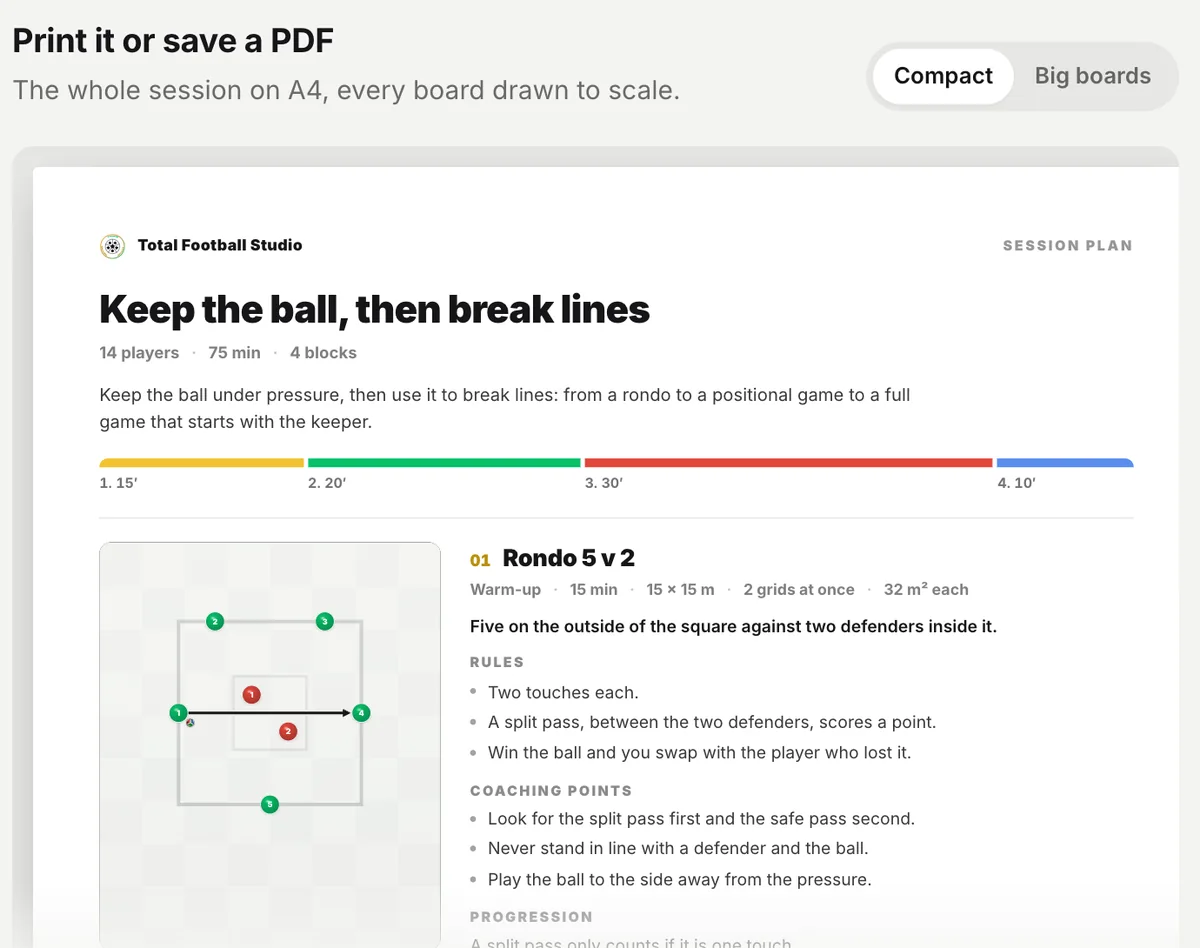
The whole session prints on one A4 sheet, or saves as a PDF, with every board drawn to scale: compact, or with big boards. Each block also saves as a picture, landscape, square or story, for the team chat.
Keep the season in one place
The free planner keeps up to 10 plans in your browser, with no sign-up. In the studio, Sessions keeps them in your account instead, filed by the day each one is for, under Coming up and Done. Beginner keeps 5 sessions; Amateur and Pro keep as many as you like. Your staff see the sessions of the boards they can see, and plans made on the free planner in the same browser come with you the first time you open Sessions. The Sessions guide has every step.
In the Studio Plan your next session on real boards Free in your browser. Every block opens as a board that moves. Open Studio →A session is one day of a week that points at a match. The rest of that week is in match preparation, step by step, and the people in it are in how to organise a football squad.
Drawn from
Every claim above is on one of these boards.
Nothing in this post teaches something the diagrams do not show. That is a rule, not a coincidence: the article is written from the systems, never the other way round.
The notebook
One system, explained, every week.
The diagram, the principle, and the detail most people miss. Unsubscribe in one click.
Follow along
Watch the systems move.
Short tactics reels, every frame drawn, no broadcast clips. Follow along wherever you scroll.
Read next
Moving Beyond X's and O's: Designing Drills with Digital Training Gear
Coaches are visual learners, but a tactical board with just arrows leaves too much to the imagination. Enter digital cones, mannequins, and hurdles.
Visualizing Roles: Why Player Images Fix Broken Tactics
A generic number 6 on a whiteboard is an abstract concept. But when a player sees their own face on the tactical board, they instantly understand their responsibility.
Why Every Coach Needs a Premium Tactics Board Tool
The days of static arrows on a whiteboard are over. The modern game requires a tool that actually moves.