Two banks of four · two up front
The 4-4-2 formation, explained
A 4-4-2 is two banks of four and two strikers. Everyone has a line, a lane and a partner. As a mid block it is small: lines about 11 m apart, 22 m from the back line to the front two, and 44 m from full-back to full-back. Its old problem is two against three in midfield, and the fix is a striker dropping onto their 6.
 Total Football StudioPausedThe 4-4-201 / 04
4 phases, one film
- Between the lines
- 11 m
- Back line to the front two
- 22 m
- Full-back to full-back
- 44 m
- The gaps in the back four
- 14 to 15 m
- Phases on the board
- 4
Measured on the board, on a 105 x 68 m pitch. A coaching guide from The 4-4-2 Playbook, not a law: adjust it to your players and your pitch.
Phase by phase
The 4-4-2, as the board plays it.
-
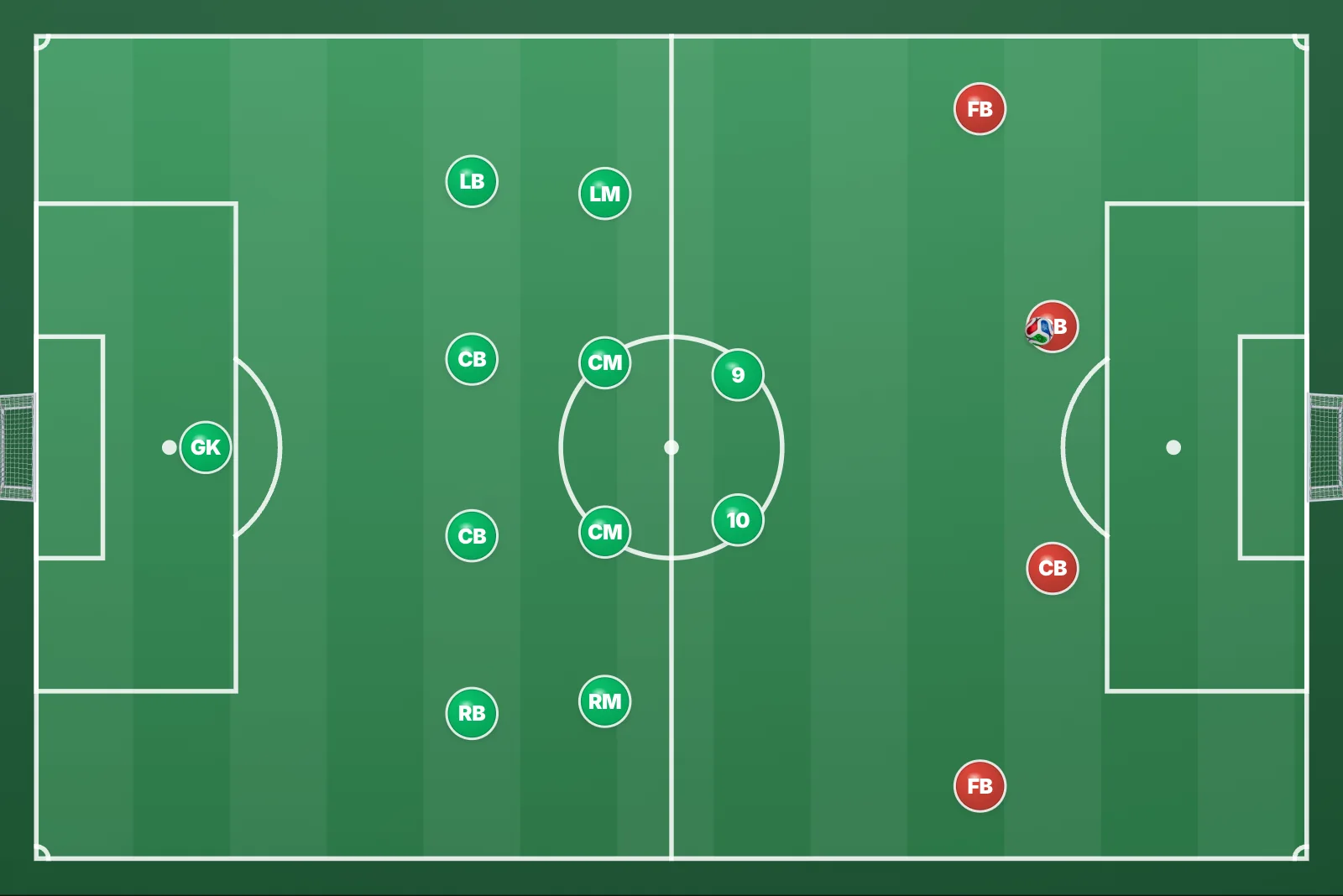 01
Two banks of four
Lines 11 m apart, 22 m from the back line to the front two, 44 m across.
A block is two numbers: front to back and side to side. Keep both small and the gaps are too small to play through. Sacchi wanted no more than 25 m from his defenders to his forwards; UEFA measured Real Madrid at Bayern in 2024 at 21.8 m, with 44 m between the full-backs.
-
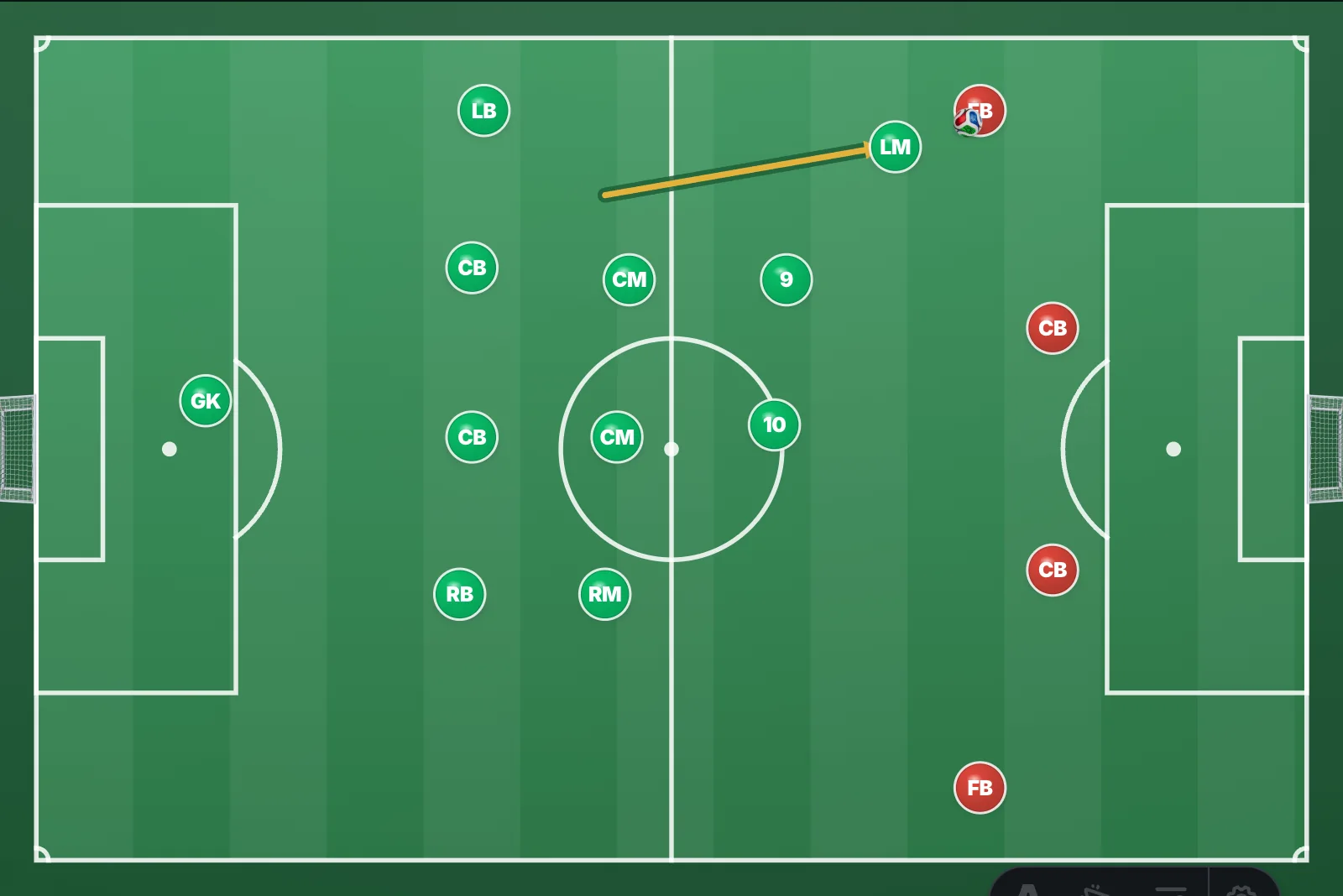 02
Slide together
Ball out wide: the block shifts across and the far full-back tucks in.
When the ball goes wide the whole block slides together, the near wide midfielder presses, and the far full-back tucks in. The penalty area is 40.32 m wide, so a back four about 44 m wide still covers it with a full-back on each corner.
-
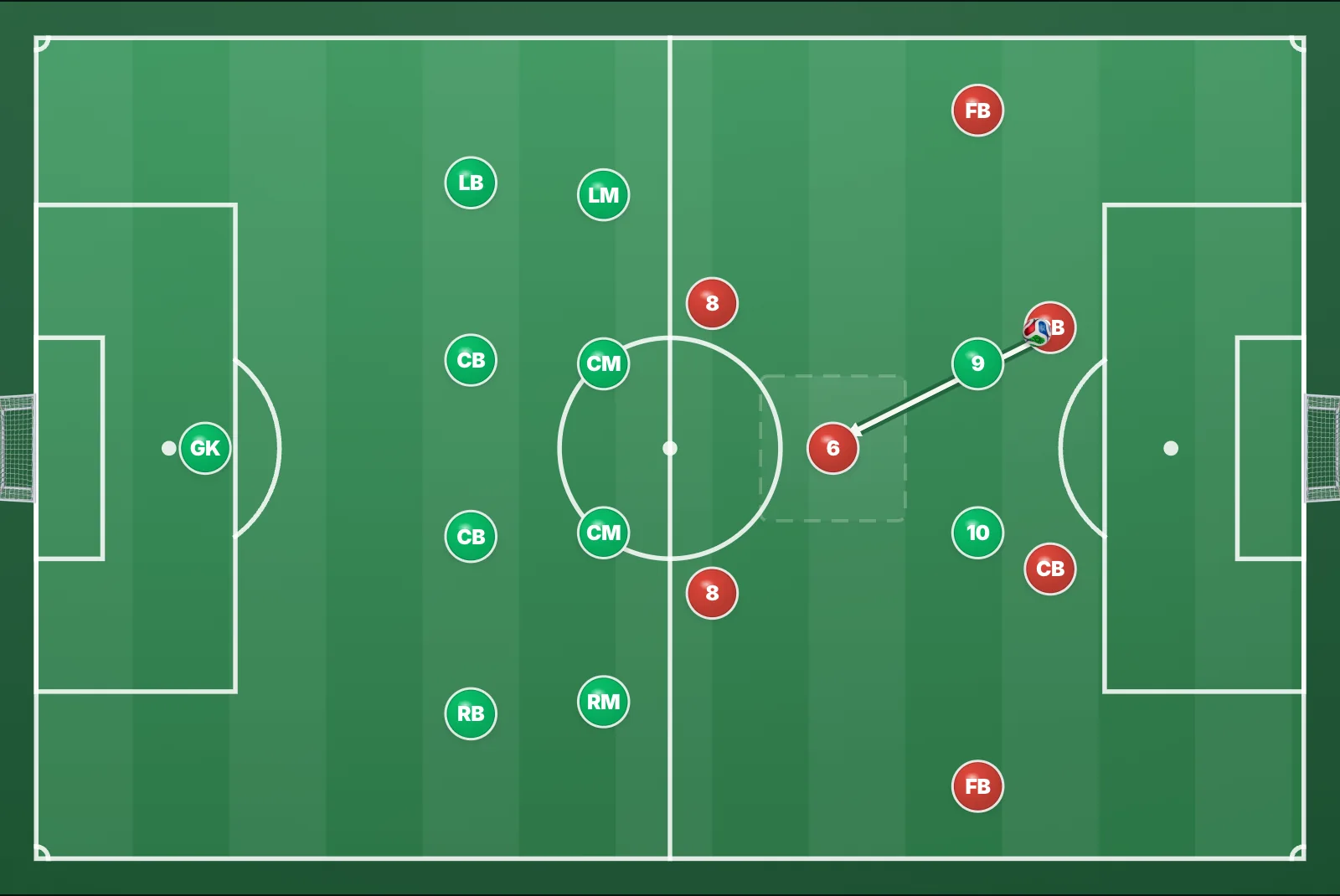 03
Two against three
Against a 4-3-3, both strikers press and their 6 is free between them.
The oldest problem in the shape. Against a 4-3-3 or a diamond both strikers press the centre-backs, their holding midfielder is free between them, and their two 8s outnumber our central pair.
-
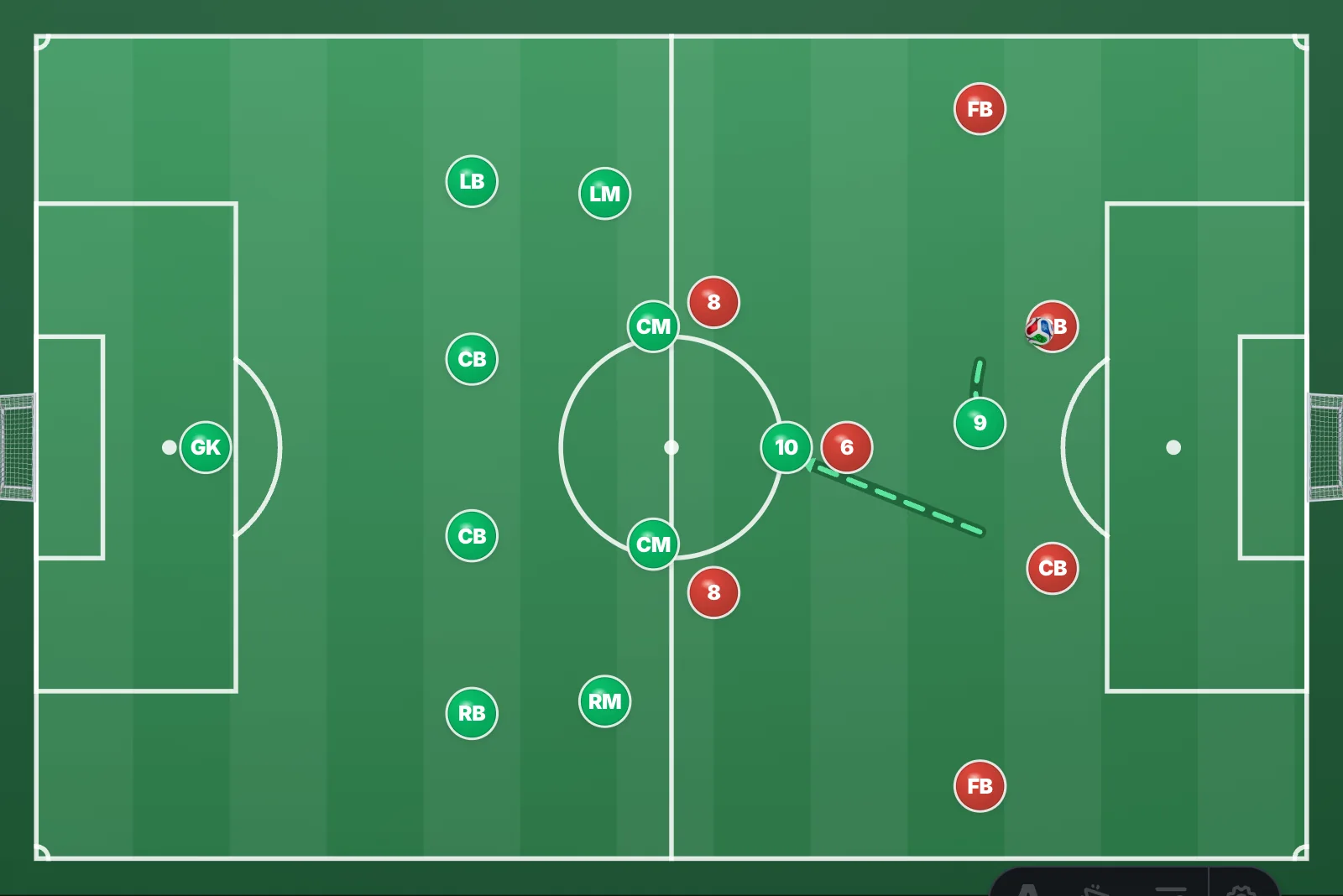 04
The fix: the 10 drops onto him
The 9 presses alone. Our two central midfielders take their two 8s: three against three.
The 10 drops onto their 6 and the 9 presses alone, on a curve. Our two central midfielders each take an 8: three against three. Without the ball the shape is now a 4-4-1-1, which was Leicester's shape when they won the league.
The roles
Who does what in a 4-4-2.
- Goalkeeper
- Behind a line that steps and drops together; the third man between the centre-backs when the team builds against three.
- Centre-backs
- Press, cover and balance: one steps to the ball, the other covers him.
- Full-backs
- Width without running, and the pair with the wide midfielder on each side.
- Central midfielders
- The pair in the middle: one goes, one stays, and they close the space between the lines.
- Wide midfielders
- Cover the flank before the ball gets there, tuck in when it is central, sprint on the counter.
- The two strikers
- Press the two centre-backs, share the work in the box, and one drops onto their 6 when needed.
What it gives you
- Width without running: four across in each line, so the flanks are covered before the ball gets there.
- A simple job for everyone: a line, a lane and a partner.
- Two strikers to press two centre-backs and share the box.
- A fast counter: two up front and two wide midfielders ready to sprint.
Where it is weak, and the fix
-
Two against three in midfield
Fix The 10 drops onto their 6, or a wide midfielder tucks in when the ball is central.
-
The space between the lines
Fix Keep the block short: 25 m or less from back to front.
-
Building against three pressers
Fix Make three at the back: the 6 drops between the centre-backs, or the keeper is the third.
-
Straight lines
Fix Players in rows make fewer angles than triangles; stagger them with the ball.
Playing against it
How to beat a 4-4-2.
- 1 Play with a midfield three. Their holding midfielder is free between the two strikers.
- 2 Put a 10 in the space between the lines, where he can receive and turn.
- 3 Press their build-up with three: two centre-backs and two midfielders can all be marked.
- 4 Switch the play fast. A block that slides is beaten by a ball that moves quicker than it does.
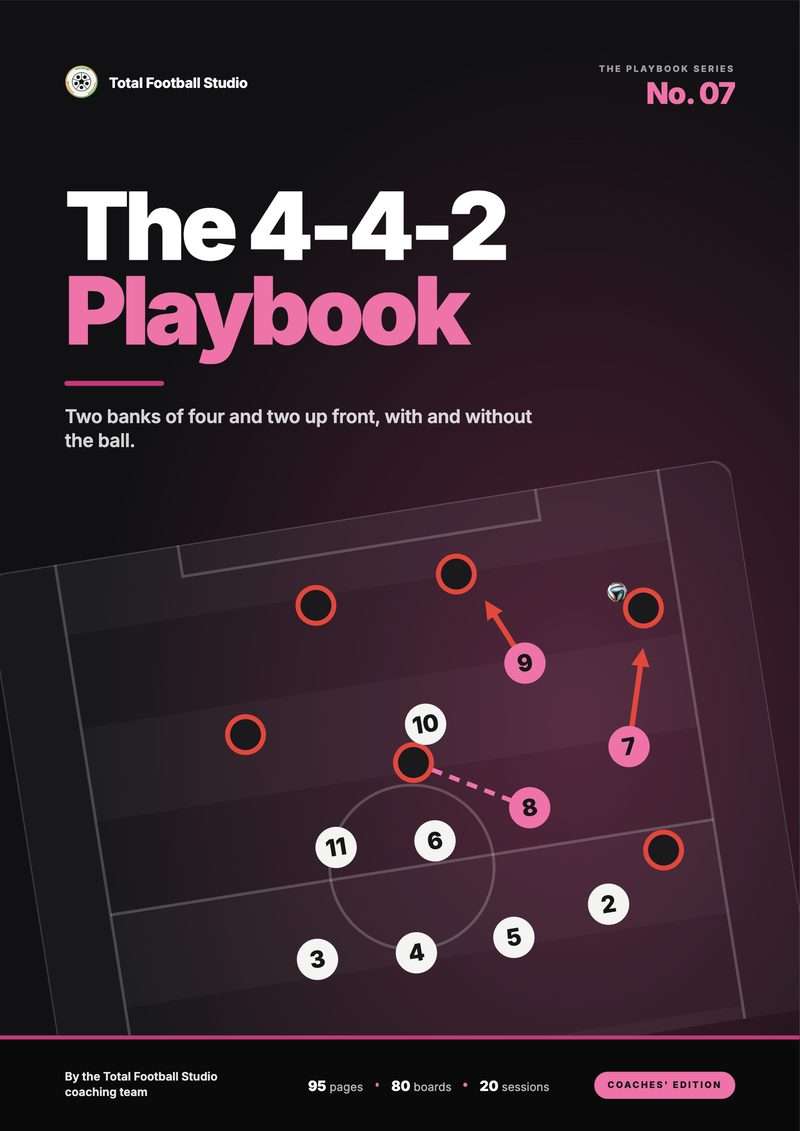
The whole system, in a book
The 4-4-2 Playbook
The 4-4-2 is the simplest shape in football to draw and one of the hardest to play well. This playbook shows every job in it: the block and its distances, the slide, the press from the front two, the midfield pair, the strike partnership, playing out, the full-back and the wide midfielder, and the counter-attack. Every board is drawn to scale and checked.
Asked about the 4-4-2
The next questions.
Is the 4-4-2 outdated?
No. Many teams that start in a 4-2-3-1 defend in a 4-4-2 or 4-4-1-1 block, and Real Madrid defended in one at Bayern in 2024. What has changed is building against three pressers, which the 4-4-2 now does with three at the back.
How far apart should the lines be in a 4-4-2?
As a coaching guide for a mid block: about 11 m between the lines, 22 m from the back line to the front two, and 44 m from full-back to full-back. Sacchi's rule was no more than 25 m from defenders to forwards.
How does a 4-4-2 defend against a 4-3-3?
One striker drops onto their holding midfielder and the other presses alone, curving to cut one side off. The two central midfielders each take an 8, so the middle is three against three.
What is the difference between a 4-4-2 and a 4-4-1-1?
Where the second striker stands. In a 4-4-1-1 he drops off onto their holding midfielder, which fixes the 4-4-2's two against three in midfield.
Other formations
-
Back four · midfield three · front three
The 4-3-3 formation, explained
-
Four lines · two holders · one 10
The 4-2-3-1 formation, explained
-
3-4-3 · 3-5-2 · a back five without the ball
Three at the back, explained
In the library