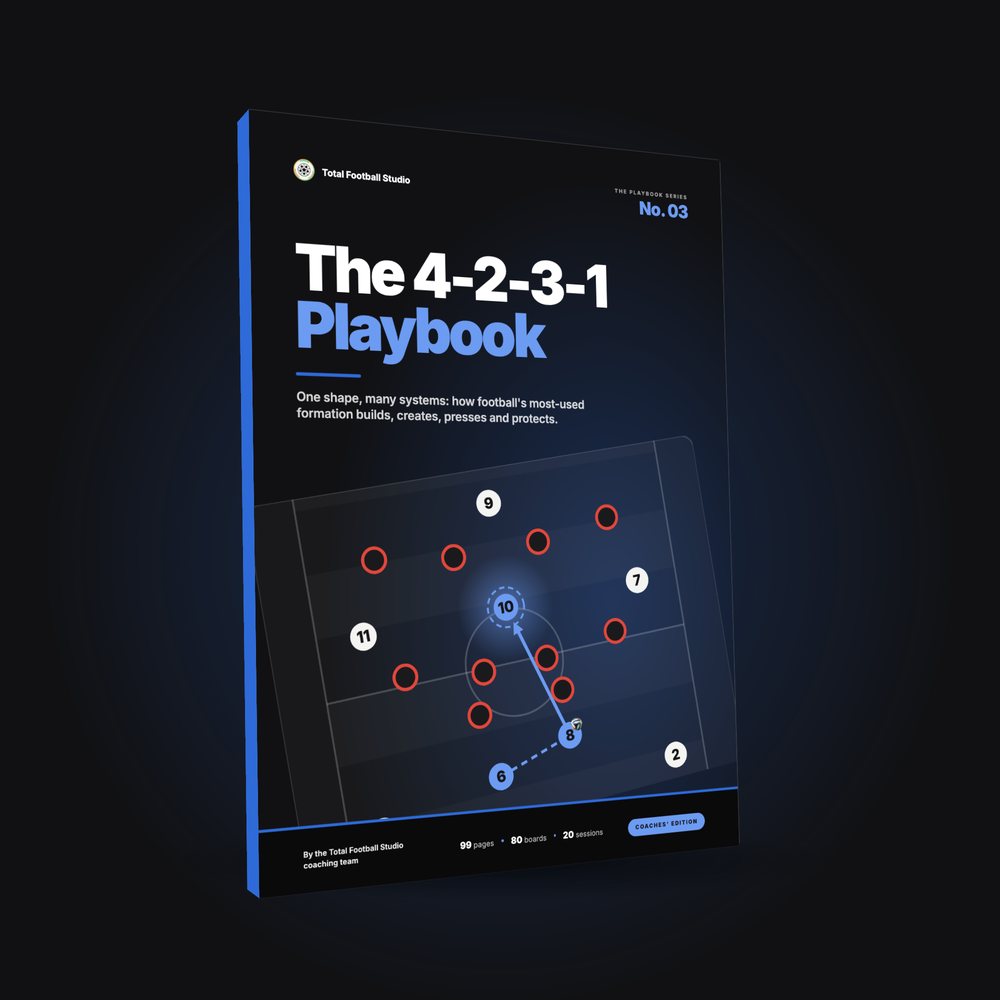
The Playbook Series · No. 03 Coaches' edition
The 4-2-3-1 Playbook
One shape, many systems: how football's most-used formation builds, creates, presses and protects.
Thirteen Premier League teams started in it. Almost none played it the same way.
- 99 pages
- 80 boards
- 20 sessions
What is inside
Thirteen Premier League teams started in it. Almost none played it the same way.
The 4-2-3-1 is where your players stand at kick-off, not what they do once the ball moves. This playbook shows how the same eleven starting positions become a 3-2-4-1, a 4-3-3 or a 2-3-5 with the ball and a 4-4-2 without it, with every idea drawn to scale and every pattern tied to a session.
- 01 The eleven roles and what each one owes the team
- 02 Four double-pivot pairings and the stagger
- 03 Four build-up bases against every first line
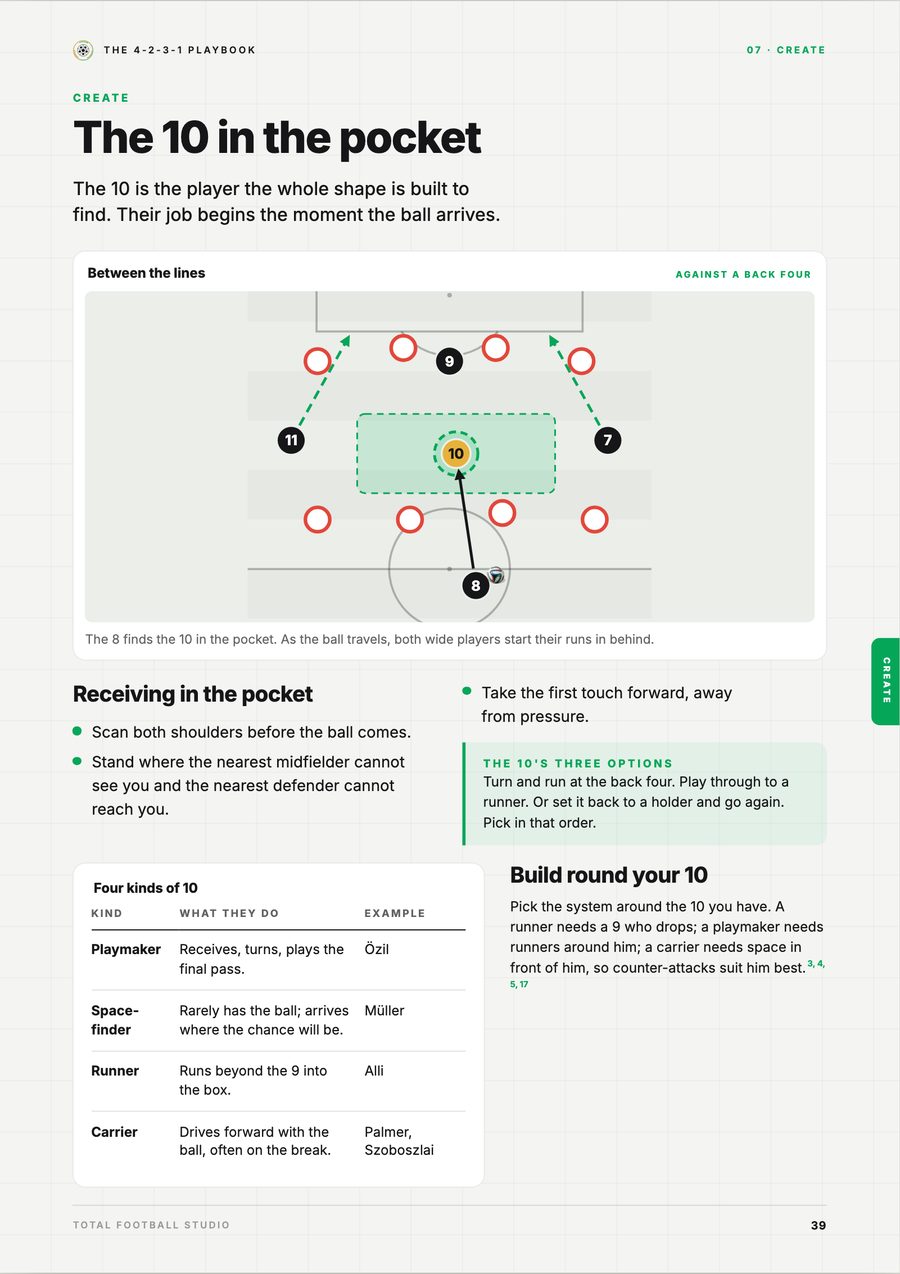
- 04 The final third: freeing the 10 and the wide men
- 05 The 4-4-2 press, the counter-attack and rest defence
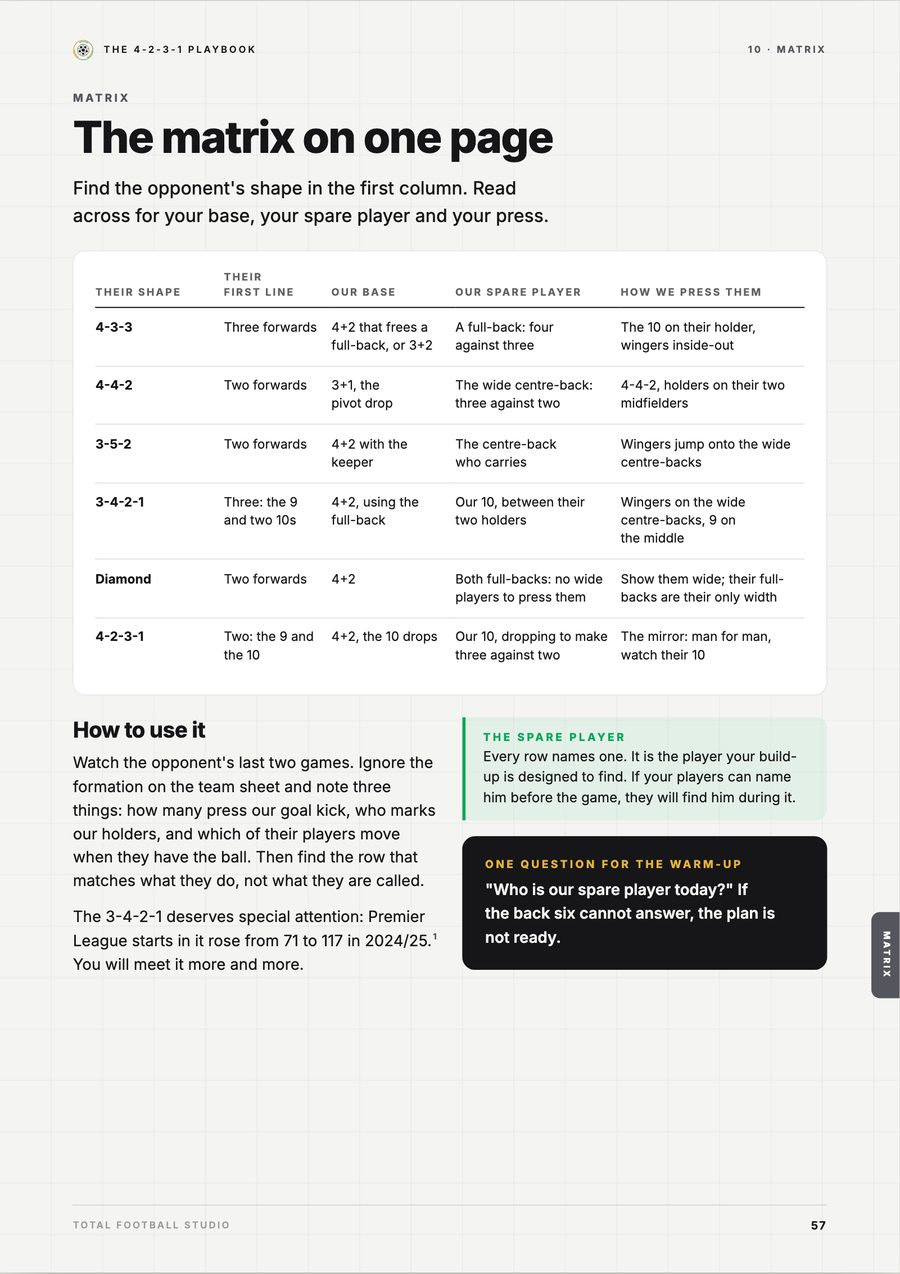
- 06 An opponent matrix for six shapes
- 07 20 sessions, from rondo to 11 v 11
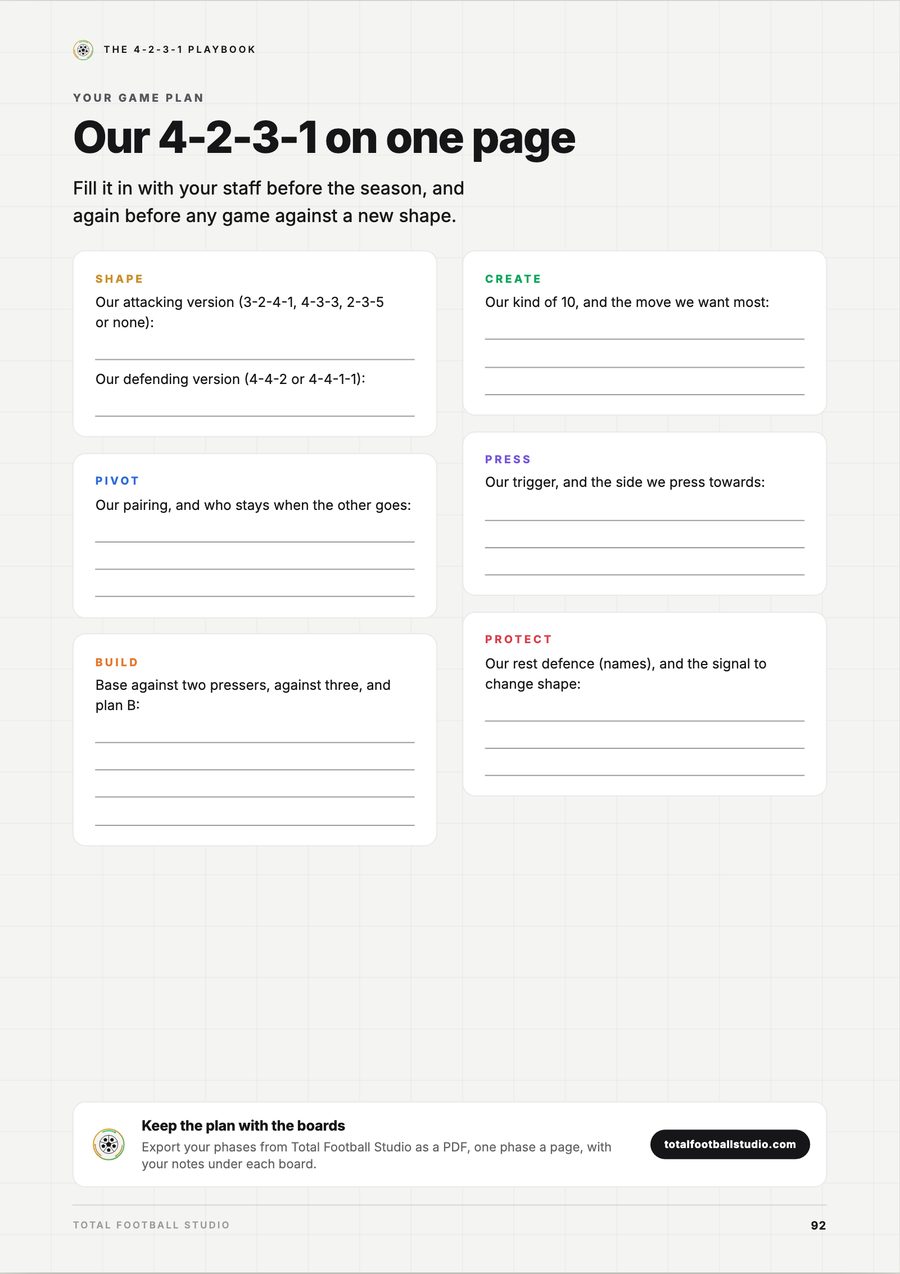
- 08 A one-page game plan and a match-day checklist
The impact
What you will be able to do after reading it.
Read it well and this is what changes for you, your staff and your players. Each point is a chapter of the book, not a promise on top of it.
- Your staff 1
- Analysis room 2
- Training ground 2
- Match day 1
- Your staff Ch. 03
Give every player a clear job
The eleven roles and what each one owes the team, from the keeper and the two holders to the 10, the inside forwards and the lonely 9.
- Analysis room Ch. 04
Choose the system inside the shape
The same starting positions become a 3-2-4-1, a 4-3-3 or a 2-3-5 with the ball and a 4-4-2 without it. Pick the version on purpose, not by habit.
- Training ground Ch. 05
Make the double pivot work
Four pairings, the stagger, and four cover rules that close the space a holder has just left, where most goals against a 4-2-3-1 come from.
- Match day Ch. 06 · 07
Free the 10 and the wide men
Count their first line, choose one of four build-up bases, then find the 10 in the pocket and use overlaps, underlaps and the rotation where the 9 drops and the 10 runs.
- Training ground Ch. 08 · 09
Press, block and break as one unit
The 4-4-2 press with the curved run and its trigger, the 4-4-1-1 mid block and the 4-5-1 low block, then a counter-attack that runs in three lanes.
- Analysis room Ch. 10 · 11 · 12
Walk into every game with a plan
An opponent matrix for six shapes, a cost table for every version, a one-page game plan to fill in with your staff, and 20 sessions picked by the problem you saw.
20 sessions and 80 boards drawn to scale turn every point into something you can show your players, then train.
Read the free samplePages from the book
Every board drawn to scale.
Read a 13-page sample
The front matter and introduction, the start of chapter 1, the first session and the back cover. PDF, 1.2 MB.
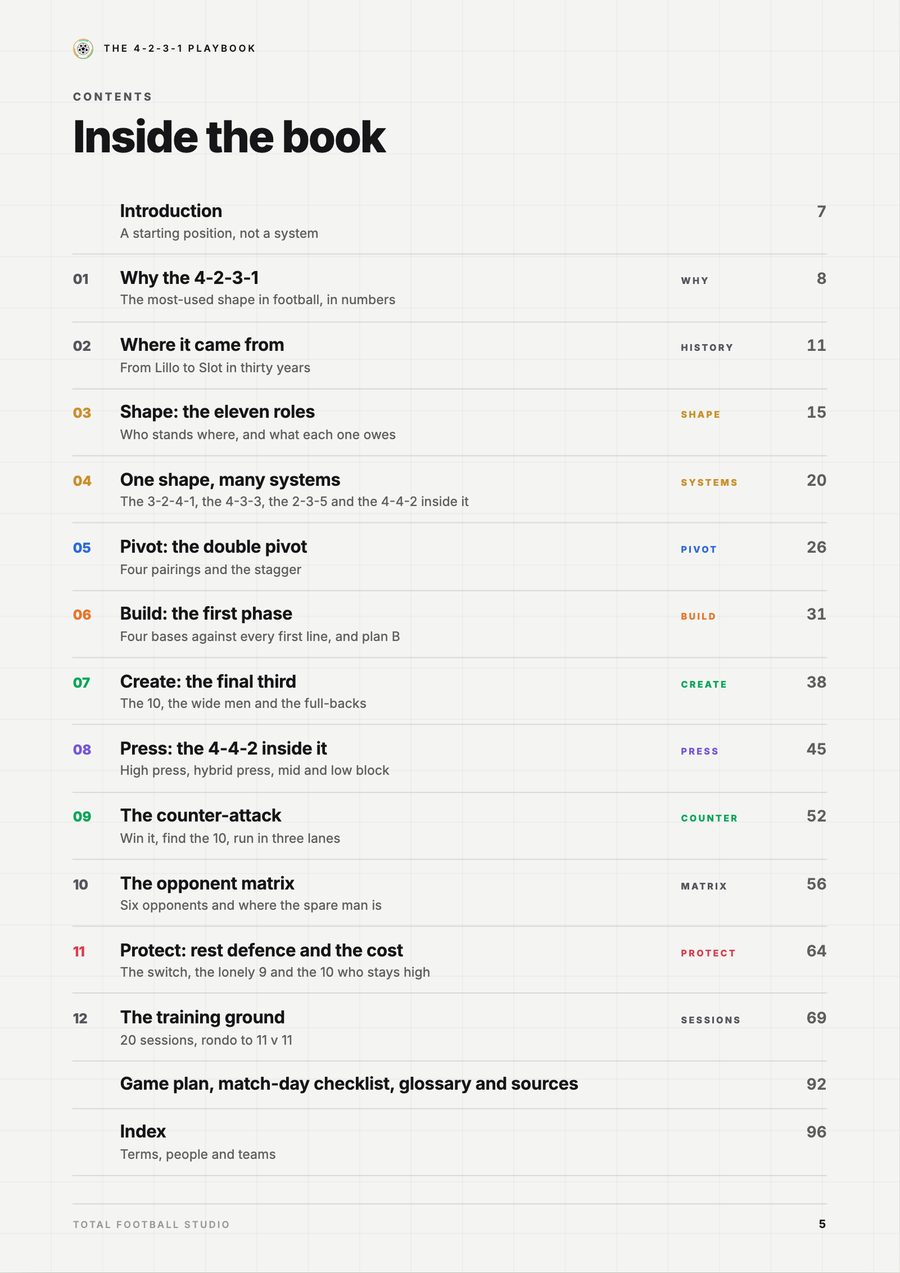
Contents
12 chapters, then the index.
Each chapter is a bookmark in the PDF, and every row of the contents page is a link to it.
- 01 Why the 4-2-3-1 The most-used shape in football, in numbers
- 02 Where it came from From Lillo to Slot in thirty years
- 03 Shape: the eleven roles Who stands where, and what each one owes
- 04 One shape, many systems The 3-2-4-1, the 4-3-3, the 2-3-5 and the 4-4-2 inside it
- 05 Pivot: the double pivot Four pairings and the stagger
- 06 Build: the first phase Four bases against every first line, and plan B
- 07 Create: the final third The 10, the wide men and the full-backs
- 08 Press: the 4-4-2 inside it High press, hybrid press, mid and low block
- 09 The counter-attack Win it, find the 10, run in three lanes
- 10 The opponent matrix Six opponents and where the spare man is
- 11 Protect: rest defence and the cost The switch, the lonely 9 and the 10 who stays high
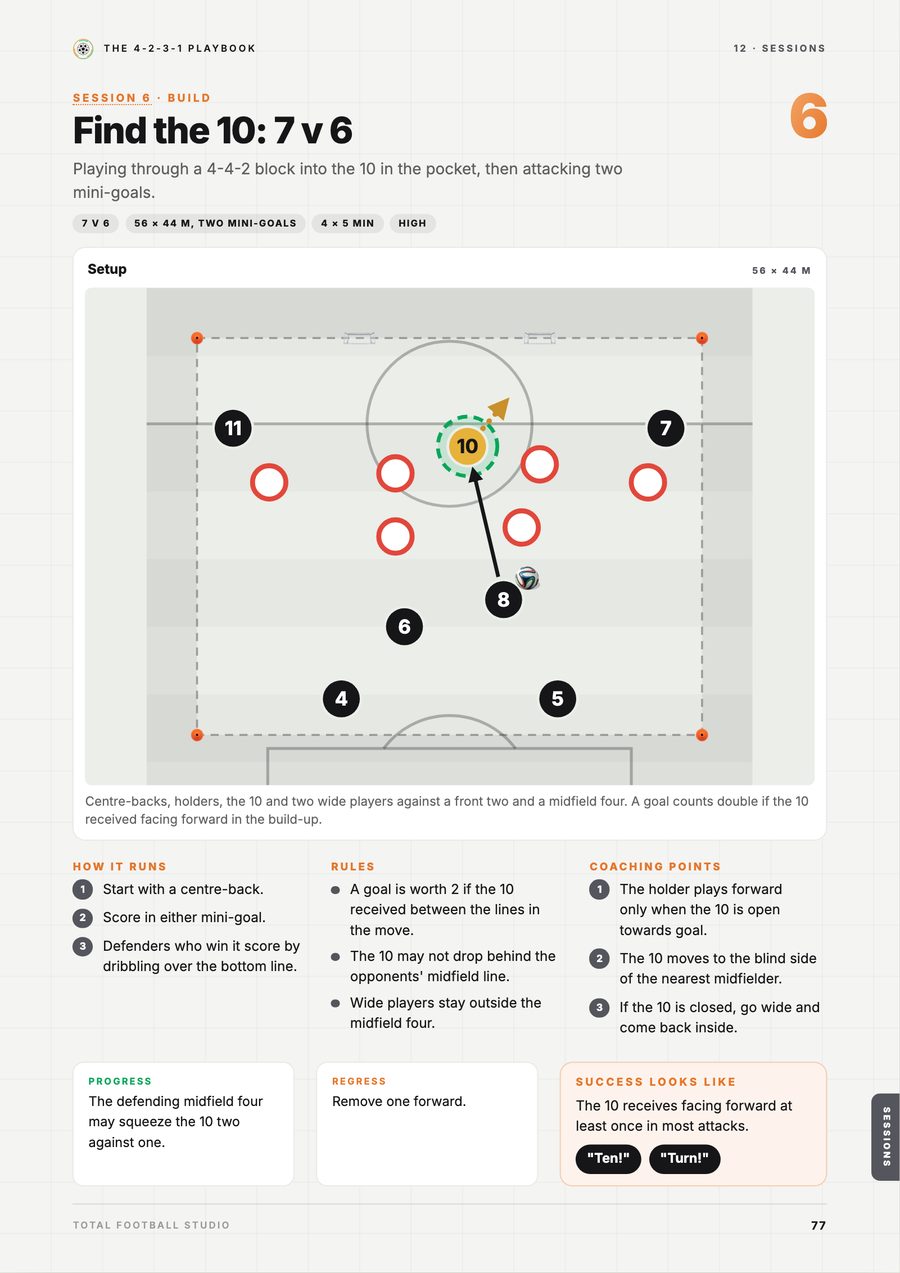
- 12 The training ground 20 sessions, rondo to 11 v 11
Coming soon
Be first to know.
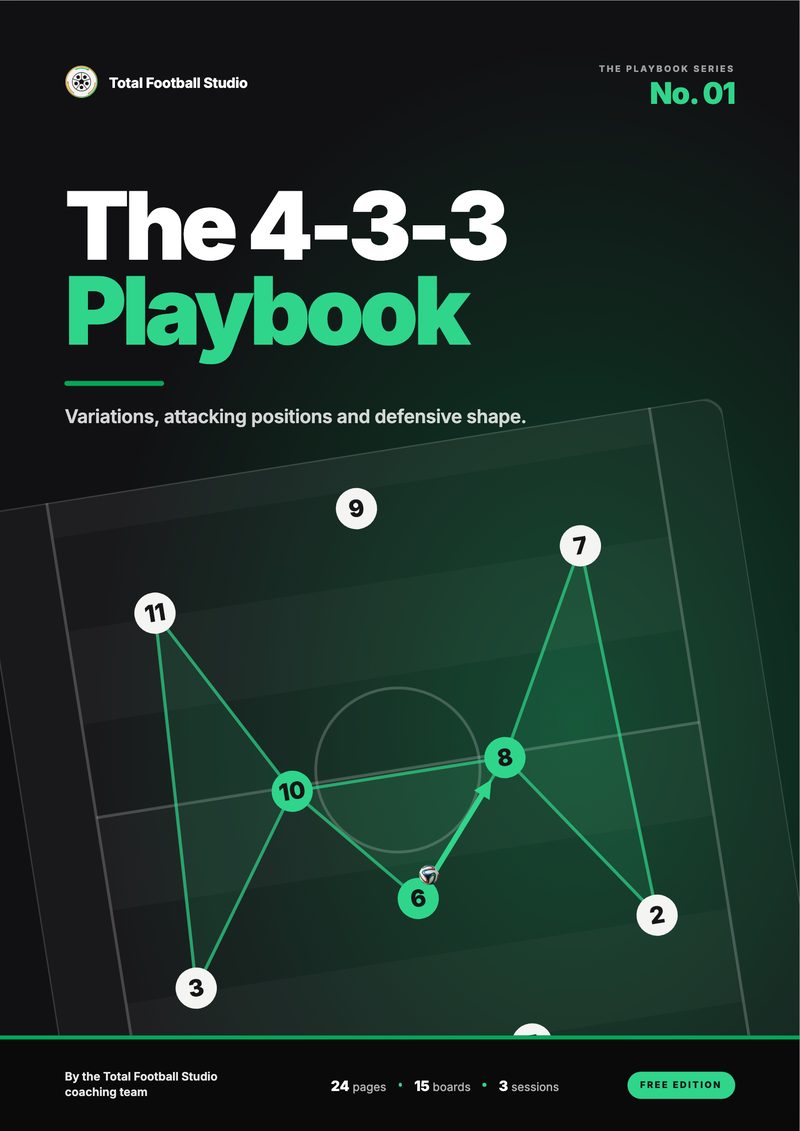
The 4-2-3-1 Playbook is finished. Join the list and we email you the day it goes on sale, with the price. Your welcome email also carries The 4-3-3 Playbook, No. 01 in the series.
The format
A PDF built to be used on the training ground.
- Format
- PDF, A4 portrait
- Length
- 99 pages, 80 boards, 20 sessions
- File size
- 4.5 MB
- Navigation
- Bookmarks for every chapter, a clickable contents page and cross-references
- Index
- Terms, people and teams
- Printing
- Laid out for A4, so every page prints as it looks on screen
- Language
- English
- Edition
- First edition, version 1.0, October 2026.
- Licence
- This copy is licensed to the buyer for personal and club coaching use. You may print pages for your own players and staff. Please do not share the file publicly, upload it or resell it. For a licence that covers a whole club or academy, write to us.
Questions
About The 4-2-3-1 Playbook
When is it out, and what will it cost?
The book is written and finished. The price is announced when it goes on sale. Join the list and we email you the day it does.
Can I read some of it first?
Yes. The free sample is 13 pages of the real book: the front matter and introduction, the start of chapter 1, the first session and the back cover.
Who is it for?
Coaches, analysts and staff who want one shared language for this part of the game, with the cost of every choice and a session for every idea.
Can I print it and share it with my players?
This copy is licensed to the buyer for personal and club coaching use. You may print pages for your own players and staff. Please do not share the file publicly, upload it or resell it. For a licence that covers a whole club or academy, write to us.
What format is it in?
A 99-page A4 PDF of 4.5 MB, with bookmarks for every chapter, a clickable contents page and an index. It opens on any phone, tablet or computer that reads a PDF, and prints on A4.
Do I need Total Football Studio to use it?
No. The book is a PDF and stands on its own. Every diagram in it was built in Total Football Studio, so you can draw the same shapes on your own board if you want to.
Open the StudioThe Playbook Series